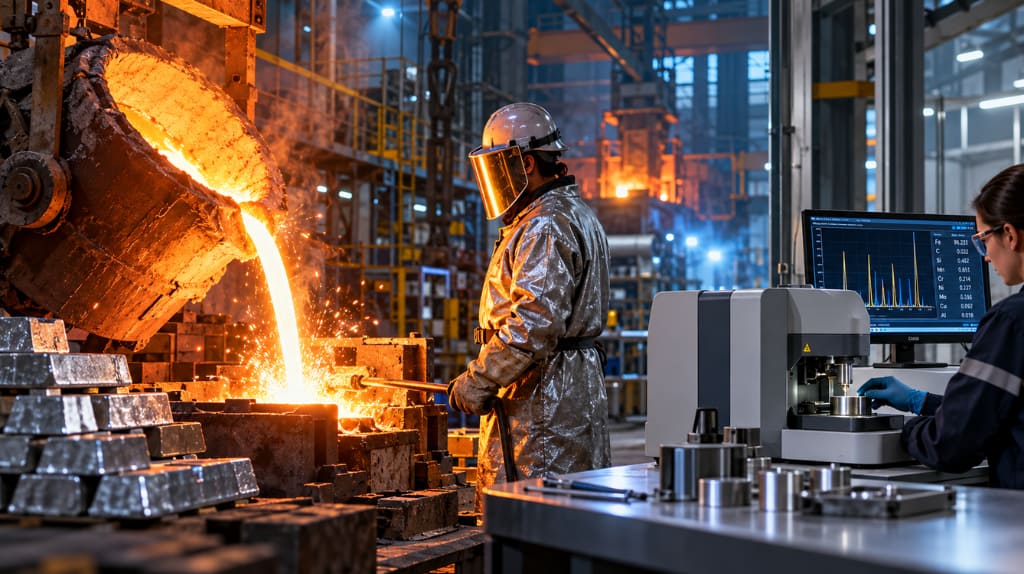
Metal melting is one of the fundamental processes in the metallurgical industry. Through heating, metallic materials change from a solid to a liquid state. They can then be transformed into components, semi-finished products and materials for a wide range of industrial sectors.
Its main applications include the production of mechanical components, automotive parts, machinery, pipes and semi-finished metal products. In addition, melting plays an essential role in metal recycling. It allows materials from industrial scrap and end-of-life products to be recovered and reused.
The process involves several stages, from raw material selection to heating in industrial furnaces. These are followed by molten metal treatment, casting and solidification. However, each material requires specific temperatures and operating conditions. Therefore, the choice of technology directly affects the quality of the final product.
One particularly important aspect is chemical composition control. Even small variations in element concentrations can change the properties of metal alloys. As a result, chemical analyses are performed throughout production to help prevent defects and non-conformities.
In this article, we explore how metal melting works, the main techniques used and why quality control is essential in modern metallurgical production.
What Is Metal Melting and What Is It Used For?
Metal melting is the process through which a metallic material changes from a solid to a liquid state by heating. This transformation occurs when the metal reaches its melting temperature, which depends on its chemical composition.
For pure metals, the transition occurs at a specific temperature. Metal alloys, however, generally melt over a temperature range. Therefore, each material requires suitable processing conditions.
It is important to distinguish three stages of the metallurgical process:
- Melting: the metal is heated until it reaches the liquid state, generally inside an industrial furnace.
- Casting: the molten metal is transferred into a mold or continuous casting system, where it takes the desired shape.
- Solidification: the material cools and returns to a solid state, forming a casting, ingot or semi-finished product.
These operations are closely connected but serve different purposes. Moreover, melting and solidification conditions directly influence the structure and properties of the final product.
Metal melting is used in many industrial sectors. In foundries, it makes it possible to manufacture components with complex geometries. In steelworks, it represents an essential stage in steel production and processing.
The process is also used to produce ingots, billets and other semi-finished products for subsequent manufacturing operations. These include rolling, extrusion, forging and machining.
Another important application is metal recycling. Remelting allows metals and alloys to be recovered from scrap and production waste. However, recovered materials must undergo careful inspections to verify their composition and suitability for reuse.
In all these applications, melting represents a crucial stage in metallurgical processing. The quality of the result depends on both temperature management and control of the material’s chemical characteristics.
How Does the Metal Melting Process Work?
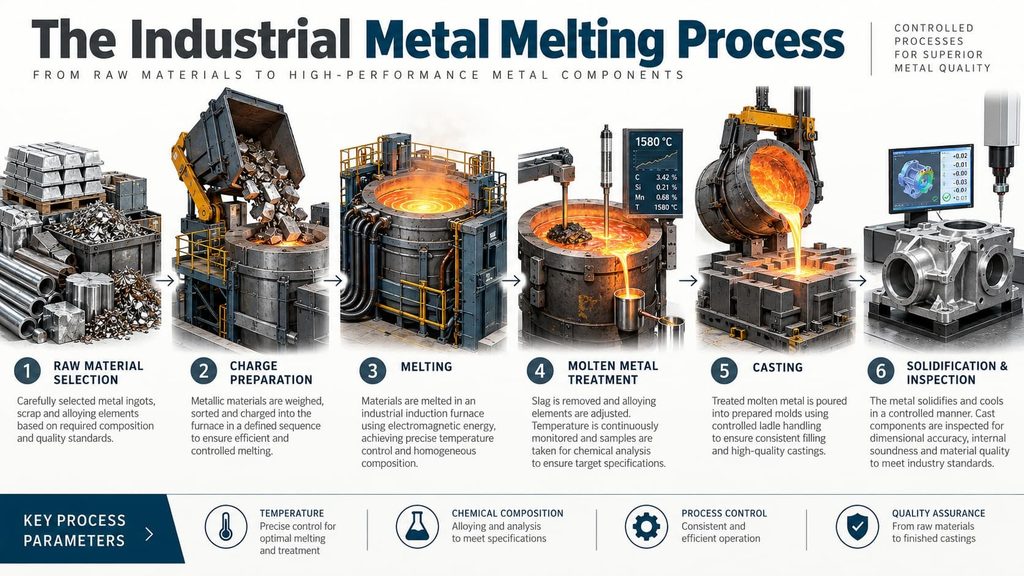
The metal melting process involves several operations, from raw material preparation to solidification. Each stage requires the monitoring of specific parameters, including temperature, chemical composition and molten metal conditions.
Although procedures vary depending on the metal and technology used, industrial melting generally follows five main stages.
- Raw material selection and preparation. The process begins with the selection of materials, including primary metals, ingots, scrap and alloys. Before charging the furnace, their quality must be verified and any contaminants removed. Proper selection helps reduce impurities and achieve a more uniform chemical composition.
- Heating and melting in the furnace. Raw materials are introduced into industrial furnaces, where they reach the temperatures required for melting. Different technologies may be used, including induction furnaces, electric arc furnaces and crucible furnaces. During this stage, temperature control is essential to ensure uniform melting and limit energy consumption.
- Molten metal treatment and impurity removal. Once the metal reaches the liquid state, it may undergo specific treatments. These operations remove slag, reduce dissolved gases and limit non-metallic inclusions. The treatments depend on the alloy and the characteristics required of the final product.
- Chemical composition control. During melting, samples are collected to verify the concentration of elements in the alloy. Analyses identify deviations from specifications and, when necessary, allow operators to adjust the molten metal composition. At this stage, optical emission spectrometry (OES) is one of the main analytical techniques used in the metallurgical industry.
- Casting and solidification. After checking the molten metal conditions, the material is transferred into molds or continuous casting systems. Cooling then causes the metal to solidify. Cooling rates and casting conditions influence the microstructure, mechanical properties and quality of the product.
Problems such as contamination, inclusions, porosity and solidification defects may occur during these operations. Therefore, monitoring production parameters and performing chemical analyses are essential to reduce waste and ensure material conformity.
Melting is only one stage of metallurgical transformation. To learn more about other industrial technologies, read our article on metalworking processes, stages and machinery.
Which Metals Can Be Melted and at What Temperatures?
Metal melting can be applied to many materials, each with specific physical and chemical properties. One of the most important parameters is the melting temperature, at which a metal changes from a solid to a liquid state.
This value varies considerably between materials. Aluminum, for example, melts at approximately 660 °C, while pure iron requires temperatures above 1,500 °C. Consequently, each process requires suitable furnaces and operating conditions.
The following table shows the approximate melting temperatures of major industrial metals and some of their applications.
| Metal | Approximate melting temperature | Main applications |
| Pure iron | 1,538 °C | Ferrous alloy production, metallurgical applications |
| Steel | 1,370–1,530 °C | Structures, mechanical components, automotive, machinery |
| Aluminum | 660 °C | Automotive, aerospace, lightweight components, packaging |
| Copper | 1,085 °C | Electrical components, pipes, industrial alloys |
| Zinc | 420 °C | Die casting, alloy production, galvanizing |
| Lead | 327 °C | Batteries, shielding, industrial applications |
| Magnesium | 650 °C | Lightweight alloys, automotive, aerospace |
| Nickel | 1,455 °C | Superalloys, high-temperature-resistant components |
| Titanium | 1,668 °C | Aerospace, biomedical applications, high-performance components |
The temperatures shown are approximate. For pure metals, they refer to melting at atmospheric pressure. For alloys, temperatures may vary depending on chemical composition.
It is important to distinguish between the behavior of pure metals and metal alloys.
A pure metal, such as copper or aluminum, has a defined melting temperature. Alloys, on the other hand, generally change from solid to liquid over a temperature range.
This range is defined by two values:
- Solidus temperature: below this temperature, the alloy is completely solid.
- Liquidus temperature: above this temperature, the alloy is completely liquid.
Between these limits, solid and liquid phases coexist. This behavior affects molten metal fluidity, casting conditions and the formation of potential defects.
Furthermore, furnace operating temperatures are generally higher than the temperature required for complete melting. This keeps the metal sufficiently fluid during subsequent processing. However, excessive heating can increase energy consumption and promote oxidation or contamination.
For this reason, knowing the alloy’s chemical composition is also essential for establishing the correct melting conditions.
To explore the characteristics and properties of different metallic materials, read our article on metal types and classification.
Main Metal Melting Techniques and Industrial Furnaces
Metal melting can be performed using different technologies, which vary in heating methods, achievable temperatures and processed materials. Furnace selection mainly depends on the type of metal, production volumes and the characteristics required of the final product.
The metallurgical industry uses both electric furnaces and fuel-fired systems. Each solution offers specific advantages in terms of energy efficiency, temperature control and production capacity.
The main technologies include:
- Induction furnaces. These use electromagnetic fields to generate heat directly within the metallic material. This technology provides precise temperature control and good molten bath uniformity. It also limits contact with combustion products. Induction furnaces are commonly used to melt steel, cast iron, copper, aluminum and other alloys. They are particularly suitable for foundries and facilities requiring production flexibility.
- Electric arc furnaces. Heat is generated by an electric arc between electrodes and the metallic material. These furnaces can reach very high temperatures and process large quantities of metal. Therefore, they are widely used in the steel industry, particularly for producing steel from ferrous scrap and other charge materials.
- Crucible furnaces. The metal is heated inside a high-temperature-resistant container called a crucible. Heat can be supplied by fuels, electrical resistance or induction. These furnaces are widely used for melting aluminum, copper, zinc and other non-ferrous alloys. Thanks to their versatility, they are common in small and medium-sized foundries, laboratories and specialized production facilities.
- Reverberatory furnaces. Heating mainly occurs through heat radiated from the furnace roof and walls, without direct contact between the fuel and molten metal. These furnaces are mainly used for melting and holding aluminum and certain non-ferrous alloys. They can also process significant quantities of material, making them suitable for continuous industrial production.
- Cupola furnaces. These vertical furnaces are mainly used for cast iron production. Metallic materials are charged together with coke and fluxes, while blown air supports combustion. The metal melts as it moves downward and is collected at the bottom of the furnace. This technology has traditionally been used in cast iron foundries, particularly for high-volume production.
The choice of technology affects not only productivity but also the metallurgical quality of molten metal. Each furnace operates under different heating, oxidation and environmental conditions.
Moreover, some systems offer greater control over chemical composition, while others require specific measures to limit contamination and alloying element losses.
Therefore, regardless of the furnace used, the process must include accurate monitoring of temperature and molten metal conditions. Chemical analyses help verify alloy conformity and maintain consistent material characteristics.
Melting, Die Casting, Extrusion and Forming: What Are the Differences?
Metal melting is one of the main technologies used in the metallurgical industry. However, it should not be confused with other processes, such as die casting, extrusion and forming. Although these operations are often connected, they have different characteristics and purposes.
The main difference concerns how the material is transformed. During melting, metal changes from a solid to a liquid state. Other processes shape the material using specific techniques, which may involve molten metal or the deformation of solid metal.
The following table summarizes the main differences.
| Process | Main characteristics | Industrial applications |
| Melting | Transformation of metal from solid to liquid through heating | Steelworks, foundries, alloy and semi-finished product production |
| Die casting | Injection of molten metal into a metal mold under pressure | Automotive, mechanical components, electronics |
| Extrusion | Deformation of metal through a die to produce profiles with a constant cross-section | Aluminum profiles, pipes, industrial components |
| Forming | Modification of metal geometry through plastic deformation without melting | Rolling, forging, stamping, component manufacturing |
- Die casting uses previously melted metal to manufacture components with complex geometries. To learn more, read our article on metal die casting: processes, materials and quality control.
- Metal extrusion, on the other hand, produces profiles and components by forcing material through a die. This technology is particularly common in aluminum processing. Our article on metal extrusion explores how the process works and its main industrial applications.
- Metal forming includes several operations that change the shape of a material without melting it. These include rolling, forging and stamping. For more information, read our article on metal forming processes and applications.
These processes may be used at successive stages of the same production chain. For example, a metal can first be melted and cast into a semi-finished product, then undergo extrusion or forming.
In every case, chemical and metallurgical quality control remains essential to ensure material quality and final product conformity.
Why Is Chemical Composition Control Essential in Metal Melting?
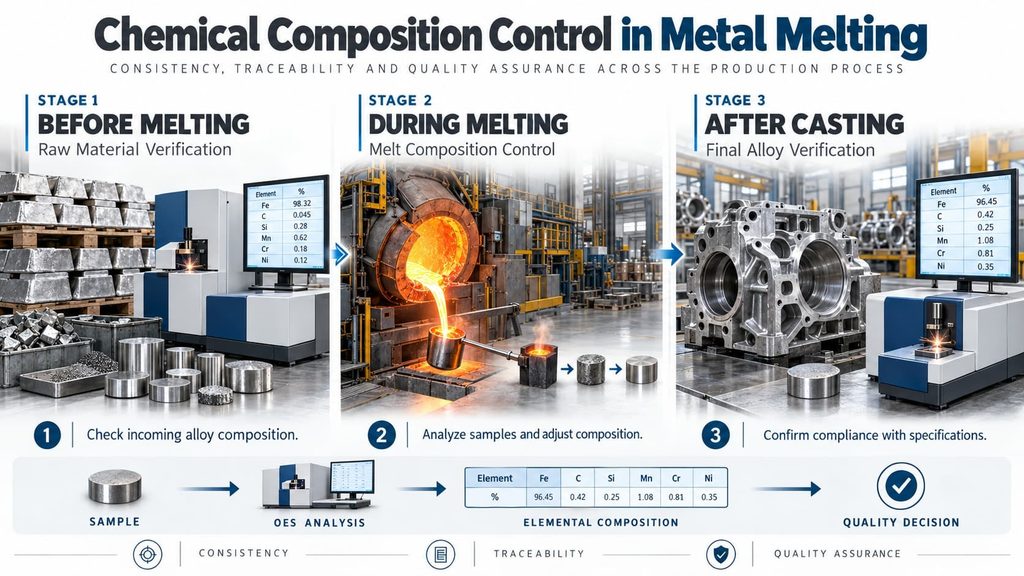
Chemical composition control is one of the most important activities during metal melting. The concentration of elements in an alloy determines many of its properties, including mechanical strength, hardness, ductility and corrosion resistance.
Even small variations can affect material behavior during processing and compromise final product quality. Therefore, chemical analyses are performed at different stages of production.
In particular, composition control involves three main stages:
- Before melting: raw materials are analyzed to verify their composition and identify potential contaminants. This is particularly important when using metal scrap or recycled materials. Proper selection helps prepare more uniform charges and reduces the risk of unwanted elements.
- During melting: samples are taken from the molten metal bath to measure alloying element concentrations. The results help identify deviations from specifications. When necessary, operators can add alloying elements or perform corrective treatments.
- After casting: additional inspections verify that the manufactured material meets the required chemical specifications. This stage also supports alloy certification and production batch traceability.
The elements monitored depend on the material. In steel, for example, carbon, silicon, manganese, chromium and nickel are particularly important. In aluminum alloys, commonly monitored elements include silicon, magnesium, copper and iron.
One of the most widely used technologies for these inspections is optical emission spectrometry (OES).
This technique identifies and quantifies the chemical elements present in a metal sample. Analysis is generally performed on a properly prepared solid sample. An electrical discharge generates radiation at wavelengths characteristic of the elements present.
Thanks to rapid measurements, OES spectrometers provide results that can be used to adjust molten metal composition before casting. Consequently, they help reduce scrap and maintain consistent alloy characteristics.
Chemical control during melting is therefore essential for preventing non-conformities, improving process stability and ensuring the metallurgical quality of manufactured materials.
GNR OES Spectrometers for Quality Control in Metal Melting
In the metallurgical industry, alloy chemical composition control is essential to ensure material quality, conformity and reliability. In steelworks and foundries, analyses must provide accurate results within short timeframes. This allows operators to inspect raw materials, monitor melting operations and make adjustments before casting.
Optical emission spectrometry (OES) is one of the most widely used technologies for these applications. By analyzing the elements present in metal samples, it determines the chemical composition of ferrous and non-ferrous alloys. Furthermore, rapid measurements support continuous production monitoring.
GNR Analytical Instruments Group develops OES spectrometers for metallurgical laboratories, steelworks, foundries and metalworking companies.
The product range includes instruments designed for different analytical and production requirements:
- S1 MiniLab 150: a compact spectrometer for rapid chemical composition analysis of metal alloys. It is suitable for routine inspections and laboratories requiring frequent measurements.
- S3 MiniLab 300: a solution for chemical analysis in laboratories and production environments. It offers versatility for analyzing major industrial alloys.
- S5 Solaris Plus: an OES spectrometer designed to analyze different metal matrices. It meets the requirements of foundries and laboratories working with various alloy types.
- S6 Sirius 500: a CMOS-based OES system developed for advanced analysis of ferrous and non-ferrous materials. It is particularly suitable for laboratories requiring high analytical performance.
- S7 Metal Lab Plus: a spectrometer for chemical composition control in metallurgical applications. It combines analytical precision with fast operation for quality inspections.
Alongside laboratory instruments, GNR also offers portable solutions such as E3 Esaport and E4 Esaport Plus. These spectrometers allow direct material analysis without necessarily transferring components to a laboratory. They are therefore useful for alloy identification and on-site inspections.
In metal melting applications, GNR OES spectrometers support several activities, from raw material inspection to the analysis of samples collected during production. They also help verify the chemical conformity of manufactured materials and document inspection results.
With these solutions, chemical composition control can be integrated throughout the metallurgical process. As a result, companies can prevent non-conformities, reduce scrap and improve production stability, while ensuring quality and traceability across the entire supply chain.
FAQ
Metal melting involves heating a material until it changes from a solid to a liquid state. The process includes raw material preparation, furnace melting and molten metal treatment. These operations are followed by chemical composition control, casting and solidification.
Many industrial metals can be melted, including iron, steel, aluminum, copper, zinc, lead, magnesium, nickel and titanium. Each material requires specific temperatures and operating conditions. Furthermore, metal alloys may behave differently from pure metals.
The melting temperature depends on the material. Aluminum melts at approximately 660 °C, copper at 1,085 °C and pure iron at 1,538 °C. Steel, on the other hand, generally has a melting range between 1,370 and 1,530 °C, depending on its alloy composition.
The main types include induction furnaces, electric arc furnaces, crucible furnaces, reverberatory furnaces and cupola furnaces. The choice depends on the material, production volume and operating requirements. For example, electric arc furnaces are widely used in steelmaking, while crucible furnaces are commonly used for non-ferrous alloys.
Melting is the process of transforming a metal from solid to liquid through heating. Die casting, on the other hand, is a casting technique in which molten metal is injected into a metal mold under pressure. It is mainly used to manufacture components with complex geometries and good dimensional accuracy.
Chemical composition is monitored through analyses performed before, during and after melting. One of the most widely used technologies is optical emission spectrometry (OES), which identifies and quantifies the elements present in metal alloys. The results help adjust molten metal composition, prevent non-conformities and ensure final product quality.