Metals are among the most widely used materials in modern industry. Thanks to their mechanical, thermal and electrical properties, they are used in sectors such as automotive, aerospace, construction, energy, electronics and industrial manufacturing.
There are many different types of metals, each characterized by specific properties that determine its behavior during processing and final use. Steels, aluminum, copper, titanium, nickel and special alloys meet very different requirements in terms of mechanical strength, weight, conductivity and corrosion resistance.
For this reason, the correct classification of metals is a fundamental step in material selection and quality control throughout the production process.
In this article, we will examine the main categories of metals, their physical and chemical characteristics, and the metallic matrices most commonly used in industry. In addition, we will explore how OES (Optical Emission Spectrometry) supports alloy identification and chemical composition control, helping ensure material conformity, reliability and quality.
Classification of Metals
Metals can be classified according to several different criteria. In industrial applications, the most common classifications are based on chemical composition, material structure and end-use applications.
The most widely used distinction is between ferrous metals and non-ferrous metals.
Ferrous metals contain iron as their main element. This category includes carbon steels, stainless steels and cast irons. Thanks to their mechanical properties and versatility, they are extensively used in construction, automotive manufacturing, mechanical engineering and infrastructure projects.
Non-ferrous metals include materials such as aluminum, copper, zinc, magnesium, nickel, titanium and their related alloys. These materials are typically selected when specific characteristics such as low weight, electrical conductivity, corrosion resistance or high-temperature performance are required.
Another common classification distinguishes between light metals and heavy metals. Light metals, such as aluminum and magnesium, have low density and are widely used in the aerospace and automotive sectors. Heavy metals, including lead, copper and nickel, have higher densities and are employed in a variety of specialized industrial applications.
There are also noble metals, such as gold, silver and platinum, which are particularly resistant to oxidation and corrosion. Although they have industrial applications, they are also widely used in electronics, medical devices and jewelry.
A particularly important category is that of special alloys, developed to achieve properties that cannot be obtained with pure metals alone. This group includes nickel-based and cobalt-based superalloys, titanium alloys and materials designed for high-temperature or high-strength applications.
Metal classification can therefore be viewed from three different perspectives:
- Chemical classification, based on alloy composition.
- Structural classification, based on crystal structure and metallurgical phases.
- Industrial classification, based on the final application of the material.
Chemical composition is one of the most important factors in correctly identifying an alloy. For this reason, spectrometric analysis often refers to the concept of a metal matrix, meaning the family of materials to which a sample belongs. Each matrix requires specific analytical configurations and quality control procedures to ensure accurate and reliable results.
Types of Metals: Key Characteristics
Despite the differences among the various categories, metals share a number of properties that make them essential for industrial applications. However, the level of performance associated with these properties can vary significantly depending on the chemical composition of the alloy.
One of the most well-known characteristics is electrical conductivity. Materials such as copper and aluminum are highly efficient at conducting electricity and are therefore widely used in the electrical and electronics industries.
Metals are also valued for their thermal conductivity, which is their ability to transfer heat. This property is particularly important in the production of heat exchangers, heat sinks and components used in energy and industrial applications.
Another fundamental characteristic is ductility, which allows metals to deform under stress without breaking. Thanks to this property, many materials can be processed through operations such as rolling, extrusion, drawing and stamping.
Closely related to ductility is malleability, the ability of a material to be shaped through compression and to assume new forms without fracturing. This characteristic is especially important in metal forming processes.
From a structural perspective, mechanical strength is another essential property. Steels, titanium alloys and nickel-based superalloys are often selected because of their ability to withstand high loads and demanding operating conditions.
Many metals also offer excellent corrosion resistance. This is the case for aluminum, stainless steels, titanium and numerous special alloys used in aggressive environments or high-humidity conditions.
Another important property is the melting point, which varies considerably from one matrix to another. Materials such as lead and zinc melt at relatively low temperatures, whereas nickel, titanium and certain superalloys are designed to operate under extreme thermal conditions.
Although these characteristics are often associated with a particular type of metal, in industrial practice they depend largely on the chemical composition of the alloy. Even small variations in elemental concentrations can affect properties such as hardness, strength, conductivity and corrosion resistance.
For this reason, simply classifying a material is not enough to guarantee its performance. Its composition must be verified through dedicated analytical techniques. In this context, OES spectrometry is one of the most widely used methods for alloy identification and chemical composition control before, during and after manufacturing processes.
The 10 Main Metal Matrices Analyzable with OES Spectrometry
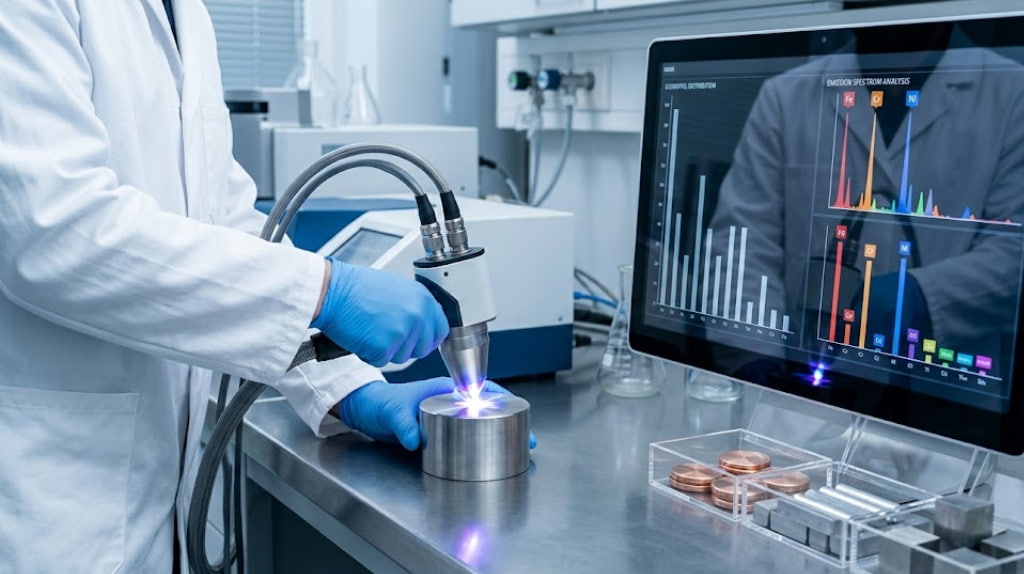
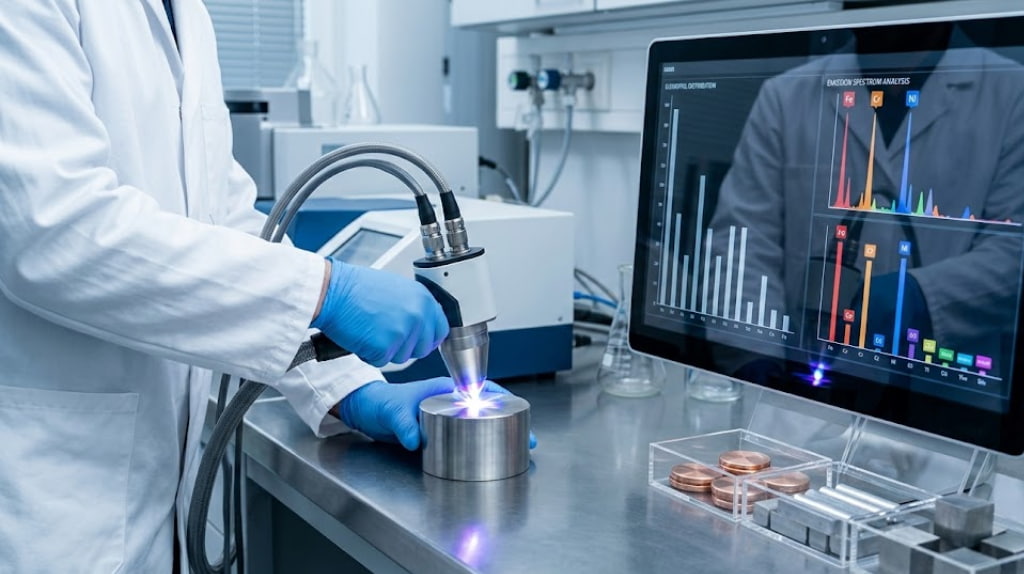
Optical Emission Spectrometry (OES) is one of the most widely used techniques for determining the chemical composition of metallic alloys. Thanks to dedicated configurations and matrix-specific calibrations, OES spectrometers can analyze a wide range of industrial materials, supporting quality control and material certification throughout the production cycle.
Iron (Fe)
The iron matrix includes carbon steels, stainless steels and cast irons. This is the most widely used family of materials in construction, automotive manufacturing, mechanical engineering and infrastructure projects. In these applications, it is essential to control elements such as carbon (C), manganese (Mn), chromium (Cr), nickel (Ni) and molybdenum (Mo), which directly influence mechanical properties and corrosion resistance.
Aluminum (Al)
Aluminum is one of the most important materials for the aerospace, automotive and construction sectors. The most common matrices include Al-Si, Al-Mg and Al-Zn alloys. Monitoring elements such as magnesium, silicon and iron is crucial for ensuring workability, mechanical performance and final product quality.
Copper (Cu)
The copper matrix includes materials such as brass and bronze, widely used in electrical, electronic and industrial applications. In these alloys, controlling elements such as tin (Sn), zinc (Zn) and lead (Pb) is essential for verifying alloy conformity and application performance.
Zinc (Zn)
Zinc alloys are primarily used in die casting and surface coating applications. Alloy quality depends on the proper balance of elements such as aluminum, magnesium and copper, which affect fluidity, strength and processing behavior.
Lead (Pb)
Lead is mainly used in battery manufacturing, radiation shielding and specific industrial applications. In this matrix, impurity control plays a particularly important role, as contaminants can affect both performance and compliance with production specifications.
Magnesium (Mg)
Magnesium alloys are valued for their exceptional strength-to-weight ratio. As a result, they are widely used in lightweight automotive and aerospace components. Controlling elements such as aluminum and zinc is essential for ensuring metallurgical stability and mechanical performance.
Nickel (Ni)
Nickel-based alloys are designed for high-temperature and highly demanding environments. They are extensively used in the energy sector, turbine manufacturing and advanced industrial systems. In these matrices, elements such as cobalt, chromium and molybdenum are closely monitored because they determine in-service performance.
Cobalt (Co)
Cobalt alloys are used in high-performance applications, particularly in the aerospace, medical and energy sectors. Their excellent resistance to wear and high temperatures requires precise chemical control to ensure consistent performance and long-term reliability.
Titanium (Ti)
Titanium is one of the most important materials in aerospace and biomedical applications. Its combination of low weight, mechanical strength and corrosion resistance makes it highly versatile. In titanium alloys, elements such as oxygen (O), iron (Fe), aluminum (Al) and vanadium (V) are frequently monitored because they directly affect final material properties.
Special Alloys
Special alloys include superalloys, high-strength materials and alloys engineered to operate under extreme conditions of temperature, pressure or corrosion. These matrices often require dedicated analytical configurations, specific calibration curves and a high level of analytical accuracy to ensure compliance with demanding technical specifications.
The ability to analyze all these matrices makes OES spectrometry an essential tool for metallic material quality control. Each alloy family presents unique analytical requirements and therefore requires dedicated control procedures tailored to its chemical composition and industrial applications.
GNR OES Spectrometers for Metal Analysis
To support quality control across different metallic matrices, GNR offers a complete range of OES spectrometers designed for industrial applications, metallurgical laboratories, foundries, steel mills and research centers.
Thanks to dedicated configurations and the ability to analyze a wide variety of materials, GNR spectrometers can determine the chemical composition of iron, aluminum, copper, zinc, lead, magnesium, nickel, cobalt, titanium and special alloys, supporting certification, alloy identification and material verification activities.
For industrial laboratories requiring high accuracy and versatility, GNR offers the S3 MiniLab 300. This spectrometer is designed for the analysis of complex alloys and applications that demand reliable and precise analytical performance.
The S1 MiniLab 150 provides a compact and practical solution for routine quality control. Its small footprint and ease of operation make it ideal for production environments where frequent and rapid checks are required.
For high-performance applications, GNR offers the S6 Sirius 500, a spectrometer developed for advanced laboratories and industrial facilities that require broad elemental coverage, fast analysis and precise alloy control.
The S7 Metal Lab Plus combines versatility and accuracy, providing a flexible solution for a wide range of metallic matrices and quality control requirements.
For particularly demanding multi-matrix applications, GNR also offers the S5 Solaris Plus, an advanced spectrometer designed to manage a broad variety of alloys and analytical configurations.
In addition to laboratory systems, the GNR portfolio includes portable instruments. The E3 Esaport allows alloy analysis directly in the field, supporting material identification and rapid quality checks in production environments.
For more advanced field applications, the E4 Esaport Plus provides enhanced performance both indoors and outdoors, enabling accurate analysis without the need to move materials to a laboratory.
Thanks to this comprehensive product range, GNR supports companies and laboratories in the analysis of the main metallic matrices used by modern industry, helping ensure material conformity, quality control and process reliability.
More information about the GNR OES product range is available here: METALS APPLICATION
Multi-Sector Quality Control Through Spectrometry
Metal classification is not merely a theoretical concept. On the contrary, it is one of the key elements in ensuring quality, compliance and reliability across industrial production processes. Each metallic matrix has specific characteristics that must be verified and controlled throughout the manufacturing cycle.
For this reason, OES spectrometry is widely used across numerous industrial sectors. In the automotive industry, for example, it is used to verify the conformity of steels, aluminum alloys and lightweight materials employed in structural components, engines and transmission systems.
In the aerospace sector, chemical composition control is essential to guarantee the performance of aluminum, titanium, nickel and other high-performance alloys used in critical applications.
Foundries rely on spectrometry to monitor alloy composition during melting and casting operations, reducing the risk of non-conformities and improving production stability. Similarly, in steel mills, alloy element control is fundamental for ensuring compliance with metallurgical specifications and industry standards.
The energy and Oil & Gas sectors also require extremely accurate material verification. In these industries, alloy composition directly affects corrosion resistance, high-temperature performance and long-term reliability under demanding operating conditions.
OES spectrometry also plays an important role in die casting and extrusion processes, where alloy quality can influence workability, deformation behavior, mechanical properties and the overall quality of the finished product.
Thanks to its speed and analytical precision, this technology supports quality control activities that go far beyond simple material identification. Proper classification and analysis of metallic alloys contribute directly to:
- Regulatory compliance
- Material certification
- Structural safety
- Production traceability
- Reduction of scrap and rework
- Improved process reliability
In an industrial environment increasingly focused on quality, traceability and performance, OES spectrometry has become a strategic tool for the control of metals and alloys used across the most important manufacturing sectors.
FAQ
The main types of metals used in industry include both ferrous and non-ferrous materials. The most common examples are carbon steels, stainless steels, cast irons, aluminum, copper, zinc, magnesium, nickel, titanium and a wide range of special alloys. Each material offers specific properties that make it suitable for particular industrial applications.
Metals can be classified according to different criteria. Chemical classification is based on alloy composition, structural classification considers crystal structure and metallurgical phases, while industrial classification focuses on the final application of the material. The most common categories include ferrous metals, non-ferrous metals, light metals, heavy metals, noble metals and special alloys.
The main properties of metals include electrical conductivity, thermal conductivity, ductility, malleability, mechanical strength, corrosion resistance and melting point. However, these characteristics depend heavily on the chemical composition of the alloy and can vary significantly even within the same material family.
Ferrous metals contain iron as their primary element and include steels and cast irons. They are generally characterized by high mechanical strength and are widely used in construction, infrastructure and mechanical engineering. Non-ferrous metals, on the other hand, include materials such as aluminum, copper, zinc, magnesium, nickel and titanium. These are often selected for specific properties such as low weight, electrical conductivity or corrosion resistance.
Chemical composition directly influences the mechanical, physical and metallurgical properties of an alloy. Even small variations in elemental concentrations can affect strength, hardness, workability and corrosion resistance. For this reason, OES spectrometry is widely used to verify material conformity, support alloy certification and ensure consistent quality throughout manufacturing processes.
A metal matrix refers to the family of materials to which a sample belongs. Iron, aluminum, copper, zinc, magnesium, nickel, titanium and special alloys are examples of different matrices. Each matrix requires dedicated calibrations, analytical curves and spectrometric configurations to ensure accurate and reliable chemical analysis results.