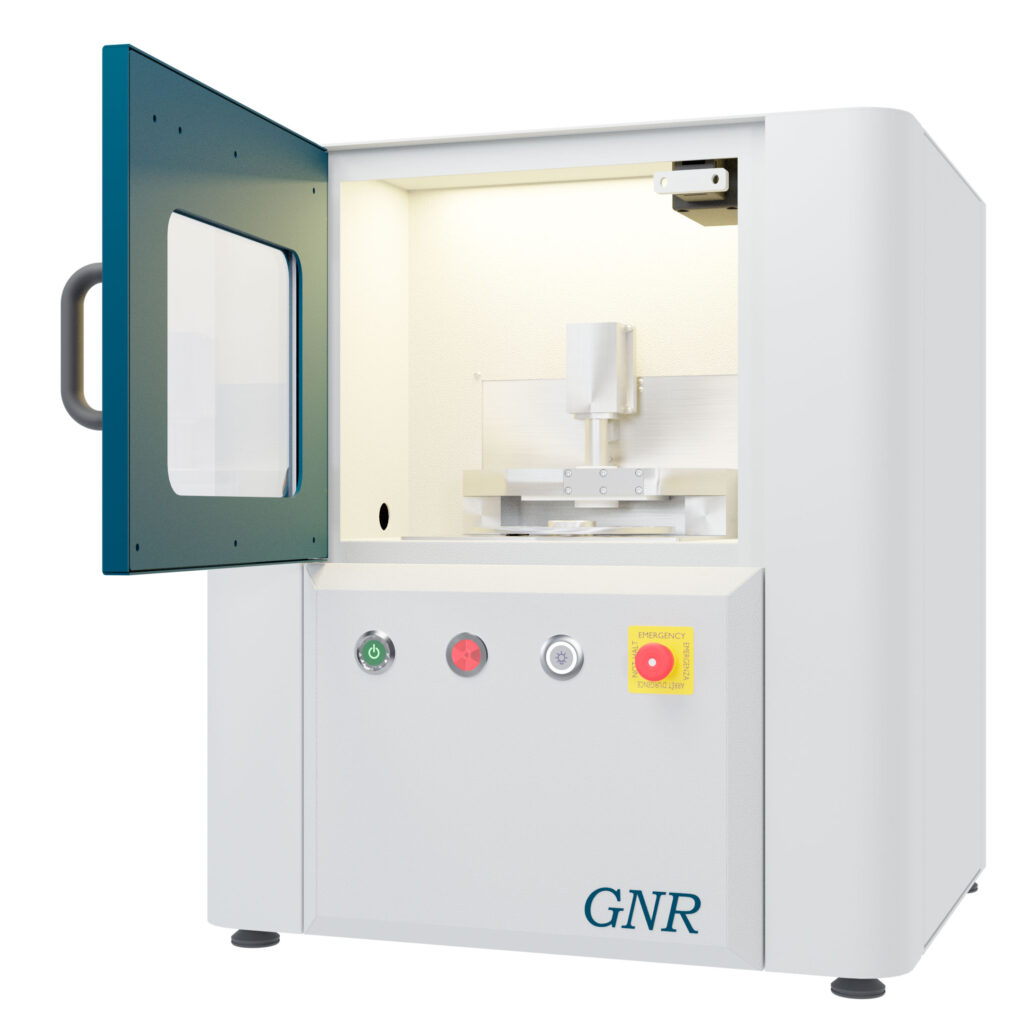
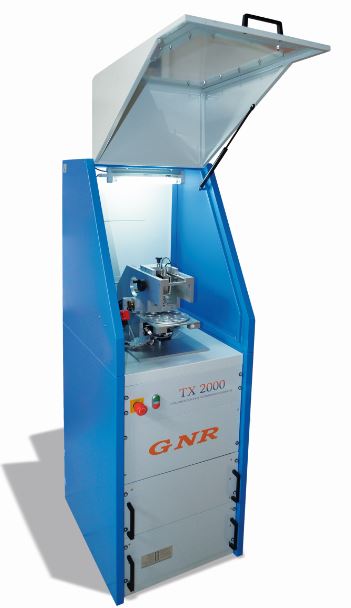
GNR, thanks to its 40 years of experience in the field, has developed a wide range of instruments to offer the most suitable solution for any need in fluorescence spectroscopy.
The GNR X-Ray portfolio covers a wide range of applications for materials characterization and quality control of crystalline and non-crystalline materials such as powders, bulk samples, thin films, or liquids.
X-Ray fluorescence spectroscopy (XRF) is a non-destructive analytical technique based on the characteristic emission of X-ray photons by atoms when they return to their ground state after excitation.
This property is used to obtain elemental information from many different types of materials across multiple fields, making fluorescence spectroscopy an effective solution whenever fast, reliable analysis is required.
The basic configuration of energy-dispersive XRF (ED-XRF) consists of:
- an X-ray tube as the excitation source
- a sample holder
- a semiconductor detector that can discriminate between photons of different energies
The angles between the incident X-ray beam, the sample, and the detector are set to 45 degrees to minimize scattered background.
TXRF is based on the same principles as ED-XRF, but with one significant difference. Unlike ED-XRF, where the primary beam hits the sample at an angle of 45 degrees, TXRF uses a grazing angle of only a few milliradians, with the detector positioned very close to the sample at 90 degrees.
Due to this grazing incidence, the primary beam is totally reflected by a flat substrate (carrier) onto which the sample is deposited as a liquid/liquid slurry and then dried, leaving only a very thin residual film, ideally a few nanometers thick.
The condition of total reflection provides improved fluorescence excitation, while the reduced thickness eliminates any matrix effects: as a result, the signal-to-background ratio is improved, and for each element there is a simple linear relationship between its characteristic fluorescence peak intensity and its concentration.
Quantitative analysis can be performed by adding an internal standard to the sample solution/suspension—i.e., an element that is not present in the original sample (typically Ga, Sc, Co, or Y). Then a small droplet, about 5–100 μL, is taken from the solution/suspension containing the internal standard and deposited onto the carrier.
The technique is generally non-destructive and suitable for solids, liquids, powders, and alloys. Depending on the sample, the analysis can be performed “as is” or after a preparation step, such as:
- dilution
- digestion
- ashing
- in-situ enrichment
In many cases, proper sample preparation is crucial to achieve a low LOD and accurate identification.
Below are the available models for X-Ray fluorescence analyzer: