
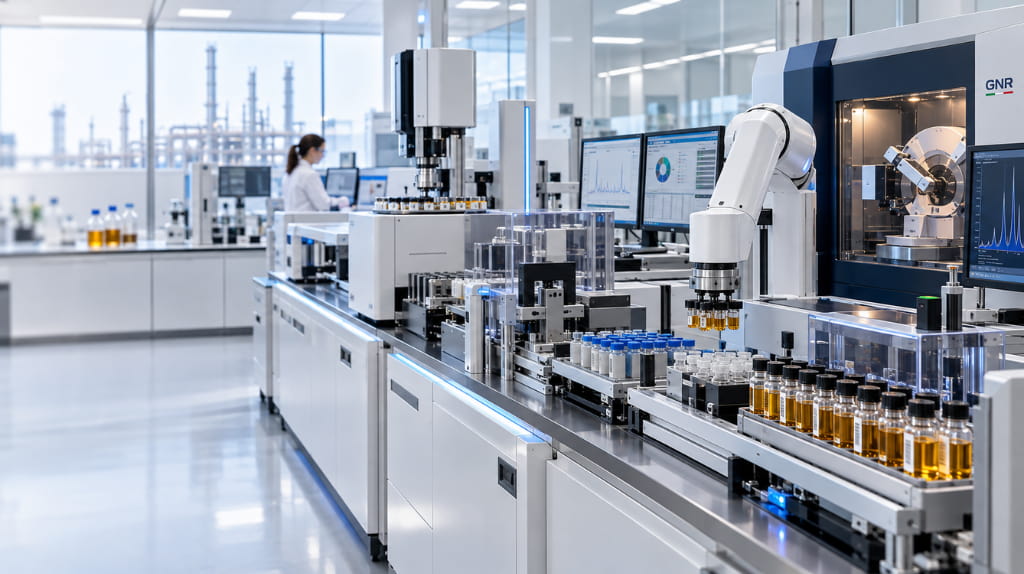
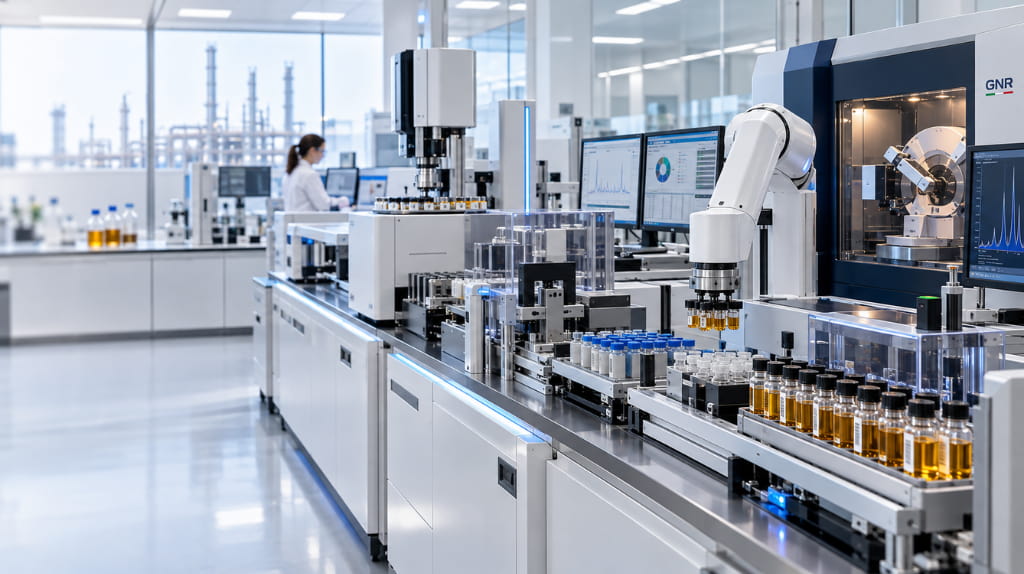
Laboratory automation encompasses instruments, robotic systems, software and integrated processes that enable laboratory operations to be performed with minimal human intervention. Its main objectives are to improve operational efficiency, increase analytical repeatability, ensure data traceability and enhance workplace safety.
Although automation is often associated with clinical laboratories and scientific research, it is becoming increasingly important in industrial analytical laboratories. In sectors such as metallurgy, steelmaking, mining and quality control, analytical processes must meet specific requirements. These include handling large numbers of samples, delivering reliable results and keeping pace with production operations.
In these environments, automation is not simply about working faster. It also helps reduce operator-related variability, improve operational accuracy and integrate analytical data into production management systems.
What Is Laboratory Automation?
Laboratory automation involves the use of mechanical, electronic, robotic and digital technologies to perform, control and coordinate tasks that traditionally require direct human intervention.
Depending on the complexity of the system, three main types of automation can be identified.
- Single-process automation focuses on a specific operation, such as sample loading, measurement or result recording. The remaining steps of the analytical process are still performed manually.
- Workflow automation, on the other hand, connects several consecutive operations. For example, a system can prepare a sample, transfer it to an analytical instrument, start the measurement and automatically collect the results.
- Total or integrated automation covers the entire process, from sample reception to analytical data management, using interconnected robotic systems and software.
In industrial laboratories, the appropriate level of automation largely depends on the role of analytical testing within production. When a test result determines whether a material is accepted or a manufacturing process can continue, analytical reliability and operational continuity become particularly important.
Why Laboratories Automate: Productivity, Accuracy and Operational Continuity
Introducing automated systems can improve several aspects of laboratory operations. Key benefits include increased productivity, greater repeatability, fewer manual errors, improved operator safety and the ability to handle large volumes of analyses. However, the reasons for investing in laboratory automation can vary considerably depending on the laboratory’s activities and production requirements.
Handling Large Sample Volumes: in steel plants, foundries, mines and large industrial facilities, laboratories may need to analyze hundreds of samples throughout the working day.
Laboratories supporting continuous production must deliver results within timeframes compatible with manufacturing operations. Manual sample preparation, handling and loading can create bottlenecks, especially when analyses are frequent and repetitive. Automation organizes these activities into controlled sequences. As a result, it reduces downtime and the need for constant operator supervision.
Improving Accuracy and Repeatability: another important objective is to improve the consistency of laboratory operations. In many analytical techniques, measurement results also depend on the conditions under which the analysis is performed. Sample positioning, measurement geometry and movement repeatability can all influence result consistency.
Robotic systems reproduce operational sequences and positioning with high precision. Consequently, they help minimize variability and make analytical measurements more comparable.
Of course, automation does not eliminate the need for instrument calibration, verification and maintenance. Nevertheless, it provides more controlled and repeatable operating conditions.
Ensuring Safety and Operational Continuity: automation also reduces direct human involvement in repetitive or potentially hazardous operations. These may include handling heavy, hot or difficult-to-manipulate samples.
At the same time, automated systems can support laboratory activities across multiple shifts. By maintaining consistent procedures, they help ensure continuous quality control and reliable analytical operations.
Types of Laboratory Automation
Laboratory automation is used in several fields, each with its own requirements and technologies.
Automation in Life Sciences and Research
In biological, chemical and pharmaceutical research laboratories, automation supports activities such as liquid handling, sample preparation, high-throughput screening and experimental data management.
These technologies enable laboratories to perform numerous operations under controlled conditions, improving experimental reproducibility.
Automation in Clinical and Diagnostic Laboratories
In clinical laboratories, automated systems manage tasks such as sample identification, handling, preparation, analysis and result transmission.
The main objectives are to ensure high traceability standards, reduce errors and efficiently process large volumes of diagnostic tests.
Automation in Industrial and Analytical Laboratories
In industrial laboratories, automation serves different purposes. Analytical activities are often directly connected to manufacturing processes and must deliver reliable results within defined timeframes.
Operations that can be automated include sample preparation, robotic handling, instrument loading, analytical measurements and result management.
One example is the determination of metal chemical composition through metal analysis and metallurgical testing, particularly using Optical Emission Spectrometry (OES). In a steel plant, samples can be automatically prepared and transferred to the spectrometer. This reduces manual intervention during repetitive operations.
Other applications include industrial oil analysis and residual stress measurement using X-ray diffraction.
These are precisely the areas in which GNR Analytical Instruments Group develops instruments and automation solutions for material analysis and industrial quality control.
Automated Sample Preparation
Sample preparation is a critical stage in many analytical procedures. For metallic samples, operations such as grinding, turning and cleaning are necessary to obtain surfaces suitable for measurement. Inconsistent preparation can compromise analytical results, even when the instrument is correctly calibrated. Automating these operations helps standardize procedures, reduce variability and improve process continuity.
Which Laboratory Processes Can Be Automated?
Laboratory automation can involve individual operations or entire workflows. The available options depend on the type of laboratory, sample characteristics and analytical instruments used.
| Process | Possible Applications |
| Sample collection and identification | Sample acquisition, identification and traceability |
| Sample transport and handling | Conveyor belts, transfer systems and robotic arms |
| Sample preparation | Grinding, turning, cleaning and other preliminary operations |
| Instrument loading | Automatic sample positioning |
| Analysis | Automatic initiation and execution of measurement sequences |
| Calibration and verification | Automated instrument verification and control procedures, where available |
| Data management | Collection, processing and transmission of analytical results |
| Quality control | Identification of out-of-specification results and management of non-conformities |
One particularly important application is found in steel plants and foundries, where large numbers of samples must be analyzed efficiently throughout the production cycle.
Depending on the facility’s requirements, these solutions can include sample collection, surface preparation or cleaning, robotic transfer, spectrometer loading, analytical measurement and result management.
The benefits extend beyond faster processing times. An automated workflow also standardizes operations and helps coordinate laboratory activities with production requirements.
These systems are developed in collaboration with customers, taking into account the available layout, sample volumes and specific analytical needs.
The Four Levels of Laboratory Automation
To assess the degree of automation in a laboratory, it is useful to distinguish four levels, ranging from completely manual operations to fully integrated analytical lines.
The following L0–L3 classification provides a practical framework for evaluating automation maturity. However, it is not a universally recognized regulatory standard.
| Level | What Is Automated | Typical Applications |
| L0 — Manual | All operations are performed by laboratory personnel | Low sample volumes, R&D, independent testing laboratories |
| L1 – Semi-Automated | Individual operations, such as sample preparation or measurement | Laboratories handling moderate sample volumes |
| L2 – Robotic Cell | Sample preparation, handling and instrument loading | Steel plants, foundries, multi-shift production facilities |
| L3 – Integrated Line | Sample transport, preparation, measurement, data management and software integration | High-volume facilities and continuous production plants |
Moving from one level to another does not necessarily follow a fixed progression. A laboratory can achieve significant improvements by automating a single critical operation.
In other situations, however, integrating multiple activities into a coordinated workflow provides greater benefits.
GNR operates in the field of industrial analytical automation, developing instruments with automated functions, robotic systems and integrated solutions designed to meet specific production requirements.
Laboratory Automation and Data Management: LIMS, MES and Laboratory 4.0
An automated laboratory does more than perform measurements. It must also collect, organize and make analytical results available.
For this reason, integrating analytical instruments with information management systems is a fundamental aspect of laboratory automation.
- LIMS (Laboratory Information Management Systems) are platforms designed to manage laboratory information. They support sample registration, analysis traceability, result storage and report generation.
- MES (Manufacturing Execution Systems), on the other hand, are used to monitor and manage production activities. Integrating laboratory systems with MES platforms connects analytical information directly to industrial processes.
In a steel plant, for example, chemical analysis results can support decisions about adjusting material composition. In other industrial environments, analytical data may help determine batch acceptance, verify compliance or plan maintenance activities.
Furthermore, automated data collection and transmission contribute to the traceability required by quality management systems, such as those based on ISO 9001, and laboratories operating according to ISO/IEC 17025.
These integrations are among the defining features of Laboratory 4.0, where analytical instruments, software platforms and production systems communicate and exchange information.
High-Volume Laboratory Automation: GNR RotrOil Automatic
Industrial oil analysis is an area where laboratory automation can deliver particularly significant benefits.
Companies operating large machinery fleets, mining equipment or complex industrial facilities often need to analyze numerous oil samples. These tests help monitor equipment conditions and identify potential signs of wear.
When sample volumes are high, manual loading and handling can require considerable time and resources.
RDE-OES technology measures the concentration of metallic elements in oil samples. As a result, it provides valuable information about component wear and the possible presence of contaminants.
Automating the analytical process allows laboratories to manage sample sequences while reducing repetitive manual operations. This is particularly important for facilities performing continuous or high-volume testing.
The main applications include:
- Mining industry, where regular oil analysis supports the maintenance of heavy equipment.
- Large machinery fleets, which require systematic monitoring of engine and component wear.
- Industrial facilities, where oil analysis contributes to preventive and condition-based maintenance.
- Specialized oil testing laboratories, which process large numbers of used oil samples.
In these environments, automation can become essential for maintaining an efficient and sustainable analytical workflow. At the same time, it helps ensure productivity and operational continuity.
Discover GNR R4 RotrOil Automatic and our solutions for industrial oil analysis.
Robotics and Precision: The StressX Robotic Diffractometer
While automation in oil analysis primarily addresses the need to handle large sample volumes, other applications benefit mainly from improved measurement accuracy and repeatability.
Residual stresses are internal stresses that remain within a material even when no external loads are applied. They can result from manufacturing processes such as machining, heat treatment, welding and surface finishing.
Measuring these stresses is essential in many industrial sectors. In fact, residual stresses can affect component behavior, fatigue resistance and service life.
A robotic system allows the measuring instrument to be positioned precisely relative to the component. It also enables repeatable measurement sequences at different points.
This approach is particularly useful when analyzing complex geometries or performing measurements in locations that are difficult to access with conventional configurations.
Robotics therefore improves positioning repeatability and the consistency of measurement procedures. However, proper instrument configuration and analytical method validation remain essential.
StressX demonstrates how laboratory automation can meet evolving industrial requirements, including increasingly complex components, stricter quality standards and the need for more accurate inspections.
Discover StressX and GNR technologies for residual stress measurement.
Standard Systems and Custom-Designed Automation Solutions
Not all laboratory automation requirements can be met with a standard system.
In some laboratories, introducing an analytical instrument with automated functions is sufficient. In others, however, a customized solution is needed to integrate with existing equipment, available space and operating procedures.
This distinction is particularly important in large industrial facilities, where each production process has specific characteristics and requirements.
For example, automated systems for steel plants and foundries can include sample handling, preparation, robotic transfer and integration with analytical spectrometers.
The objective is to create a workflow that meets the facility’s operational needs without introducing unnecessary complexity.
Furthermore, custom system design makes it possible to consider several critical factors from the outset. These include space requirements, safety systems, software interfaces, maintenance procedures and compatibility with existing workflows.
Laboratory Automation: GNR Instruments and Industrial Applications
GNR’s expertise in analytical instrumentation covers several technologies that can be integrated into automated laboratory workflows.
The main applications fall into four areas.
Chemical and Petrochemical Analysis:With RotrOil Automatic, laboratory automation enables the management of RDE-OES analytical sequences in facilities handling large sample volumes.
Residual Stress Measurement: The StressX robotic diffractometer combines XRD technology with robotic positioning systems. This solution meets the need for accuracy and repeatability when analyzing complex industrial components.
Steel Plants and Foundries: Custom-designed automation solutions connect sample preparation and handling operations with analytical instruments. These robotic systems are developed according to specific production requirements.
Industrial Quality Control: GNR analytical technologies, including OES and XRD, can be integrated into workflows where measurement results are used to verify material compliance and support production decisions.
GNR’s contribution therefore extends beyond the development of analytical instruments. It also includes the design of integrated solutions that bring together analysis, automation and data management within a coordinated workflow.
How to Choose the Right Level of Laboratory Automation
Choosing the right level of laboratory automation starts with a thorough assessment of existing operations.
The first factor to consider is the number of samples requiring analysis. A laboratory performing only a few measurements per day has very different needs from a facility operating continuously across multiple shifts. It is also important to evaluate the criticality of analytical results, required turnaround times and potential consequences of errors. Other factors include laboratory layout, availability of qualified personnel and compatibility with existing equipment.
In general, several common situations can help guide the decision:
- High sample volumes: Automating the workflow or introducing an integrated analytical line can improve productivity and reduce processing times.
- Measurement accuracy: Robotic systems can improve the repeatability of movements and sample positioning.
- Data traceability: Integrating analytical instruments with information management systems, such as LIMS and MES, supports reliable data collection and exchange.
- Specific production requirements: A custom-designed automation solution may be more suitable than a standard system when the analytical process has unique characteristics.
Finally, the evaluation should consider more than the initial investment. Operating costs, maintenance, operator training and expected long-term benefits are equally important when selecting the most appropriate automation strategy.
When Laboratory Automation Is Not Cost-Effective
Laboratory automation is not necessarily the best solution for every laboratory.
When sample volumes are limited, for example, the cost of an automated system may not be justified by the potential time savings.
The same applies to laboratories handling highly diverse samples that require frequent procedural adjustments or specialized operator intervention.
Another critical factor is process stability. Automating a procedure that has not yet been properly defined can transfer existing inefficiencies and problems from the manual workflow into the automated system.
Furthermore, introducing robotic systems requires adequate space, technical expertise and carefully planned maintenance procedures.
For these reasons, every laboratory automation project should begin with a detailed assessment of actual operations. This helps identify which activities can genuinely benefit from automation.
The objective is not to automate as many tasks as possible, but to select solutions that deliver measurable improvements in laboratory performance.
Laboratory Automation and the Future of Industrial Quality Control
Laboratory automation is transforming the role of analytical laboratories within industrial production processes.
Traditionally focused on performing measurements, laboratories can now become increasingly integrated with manufacturing operations. As a result, they can provide timely, reliable information to support quality control.
The ability to handle large sample volumes, standardize procedures, improve positioning accuracy and automatically share analytical results offers significant advantages across many industries.
However, the evolution of laboratory automation goes beyond productivity. Increasingly complex materials and industrial components require more advanced analytical technologies. These must be supported by systems capable of performing operations with high repeatability.
With instruments such as RotrOil Automatic and StressX, along with customized robotic systems for steel plants and foundries, GNR contributes to this transformation. By combining analytical expertise with industrial automation solutions, the company helps laboratories meet the evolving requirements of modern manufacturing.
FAQ
Laboratory automation refers to the technologies, instruments, robotic systems and software used to automate laboratory operations, from sample preparation to result management. Its main objectives are to improve efficiency, repeatability, safety and traceability.
Many laboratory activities can be automated, including sample identification, handling, preparation, instrument loading, analytical measurements, data collection and report generation. The appropriate level of automation depends on the laboratory’s specific requirements.
Automation is particularly beneficial when laboratories handle large sample volumes, perform repetitive operations, require short turnaround times or need high measurement accuracy and repeatability. However, cost-effectiveness also depends on operating costs and process characteristics.
Automation can improve both. In addition to reducing the time required for repetitive operations, robotic systems enable controlled movements and precise positioning. Consequently, they help improve measurement repeatability and reduce operational variability.
A semi-automated system automates one or more operations but still requires manual intervention. A robotic cell, on the other hand, integrates several coordinated activities, such as sample handling, preparation and instrument loading.
Industrial oil analysis can be automated using instruments equipped with sample handling and loading systems. GNR RotrOil Automatic uses RDE-OES technology to support automated analysis of large numbers of oil samples, reducing repetitive manual operations.
A robotic diffractometer performs X-ray diffraction measurements using robotic positioning systems. GNR StressX is designed for residual stress analysis, including measurements on components with complex geometries.
Automated systems can reduce sample handling and preparation times, improve operational repeatability and support continuous quality control. Furthermore, customized solutions can be developed to meet specific production requirements.
Integration is achieved through software interfaces that enable data exchange between analytical instruments and management systems. LIMS platforms support laboratory data management, while MES systems connect analytical information with manufacturing processes.
Yes. In industrial laboratories, automation helps standardize analytical procedures, reduce repetitive manual operations and deliver results within production deadlines. It is particularly valuable in metallurgy, steelmaking, mining and industrial maintenance.