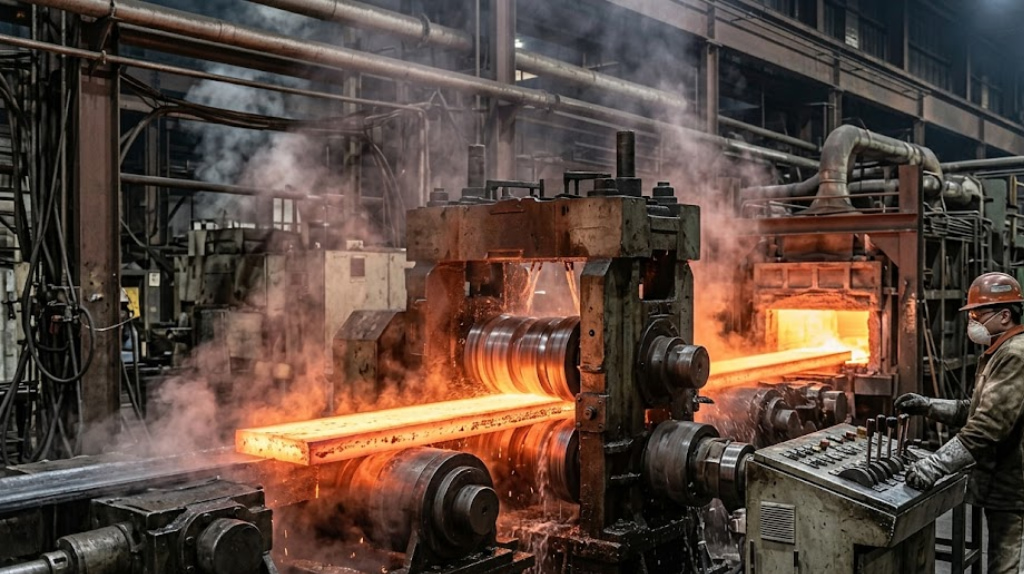
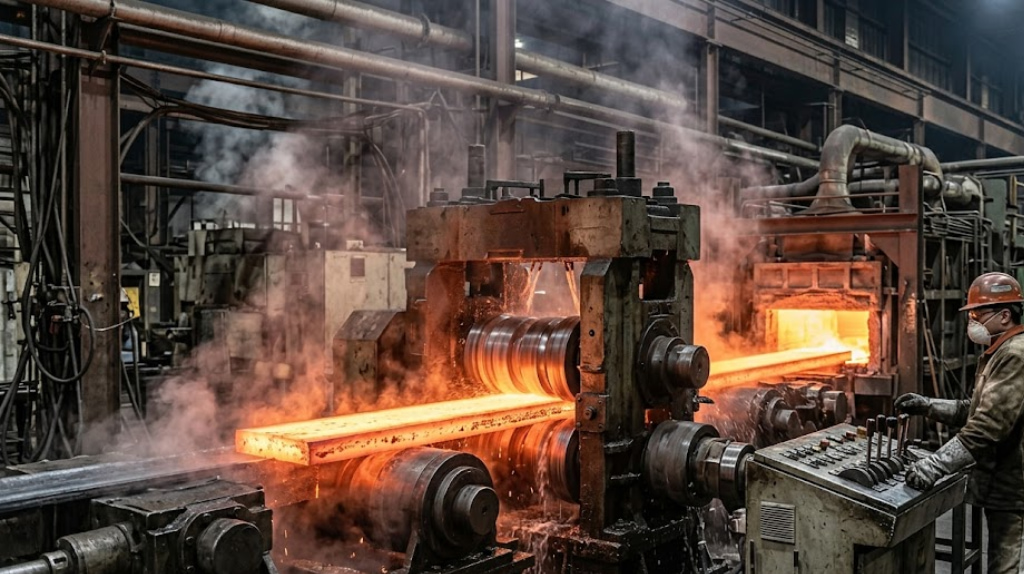
A steel coil for the automotive industry, an aluminum sheet for food packaging and a structural beam used in construction all have one thing in common: before becoming finished products, they have almost certainly passed through a rolling mill.
Metal rolling is one of the most widely used plastic deformation processes in manufacturing. It transforms large semi-finished products into sheets, strips, bars and profiles with controlled thickness and dimensions. For this reason, it plays a key role in numerous industrial sectors, from mechanical engineering and energy to infrastructure and transportation.
Although the process may appear straightforward, it relies on a careful balance of operating parameters. Temperature, roll pressure and alloy composition all influence the final result. Even a small deviation from specification can alter the mechanical properties of the rolled product.
What Is Metal Rolling?
Metal rolling is a plastic deformation process in which a metal passes between two or more rotating rolls. As it moves through the rolls, its thickness is reduced or its cross-section is shaped to the required geometry. Unlike machining operations, rolling changes the shape of the material without removing it or generating chips.
Different alloys respond differently to deformation. Steel, aluminum, copper, brass and specialty alloys each have their own mechanical behavior during rolling. Their ductility, strength and chemical composition determine both the processing parameters and the characteristics of the finished product.
As a result, the process is always adapted to the material and its intended application. A sheet designed for automotive body panels, for example, requires different rolling conditions than a structural bar or a strip intended for electrical applications.
Rolling belongs to the broader family of metal forming processes, together with extrusion, forging and stamping. If you would like to explore this topic further, you can also read our article on Metal Forming.
How the Metal Rolling Process Works
Every rolling mill follows a well-defined sequence of operations. The exact parameters, however, depend on the alloy, the desired product and whether the process is performed hot or cold.
- The process begins with a semi-finished product such as a slab, billet or bloom. Before rolling starts, the material is inspected and prepared. In hot rolling, it is also heated to the required temperature. This stage is less visible than the rolling operation itself, but it is equally important. For example, an uneven temperature distribution can already affect how the metal deforms during the first passes through the rolls.
- The material then enters the rolling mill, where it passes through a series of rotating rolls that progressively compress it. Each pass either reduces the thickness or modifies the cross-section of the workpiece. In most industrial plants, the required deformation is not achieved in a single step. Instead, it is distributed over multiple consecutive passes. This approach provides better control of the material while reducing stress on both the workpiece and the rolling equipment.
- Throughout the process, the flatness, geometry and dimensions of the product are continuously monitored. Even small adjustments to the roll gap can make a significant difference when tight dimensional tolerances are required.
- Once rolling is complete, the metal is cooled according to procedures suitable for the specific alloy. Additional treatments may then follow, including annealing, pickling or surface finishing.
- The final stage is quality control. In addition to dimensional inspections, the required material properties are also verified. Temperature, roll pressure, rolling speed and chemical composition are all closely related to the quality of the finished product and its performance during subsequent manufacturing operations.
Hot Rolling and Cold Rolling: Key Differences
The choice between hot rolling and cold rolling depends primarily on the properties required in the finished product. While both processes rely on the same fundamental principle, they operate under very different conditions and produce different results.
- Hot rolling is performed above the metal’s recrystallization temperature. Under these conditions, the material deforms more easily, allowing substantial thickness reductions in a relatively small number of passes. For this reason, hot rolling is widely used to produce thick plates, bars, structural sections and other semi-finished products. On the other hand, the high temperatures involved may promote surface oxidation and make it more challenging to achieve very tight dimensional tolerances.
- Cold rolling, by contrast, is carried out below the recrystallization temperature, often at room temperature. Because the material is harder to deform, higher rolling forces are required. The process, however, delivers a smoother surface finish, tighter dimensional accuracy and improved thickness consistency. It also causes work hardening, increasing the mechanical strength of the material.
There is, however, one important aspect that should not be overlooked. Cold deformation can introduce residual stresses within the material. In some applications these stresses have little effect, while in others they can influence subsequent operations such as welding, bending or heat treatment. For this reason, residual stresses are often evaluated as part of the quality control process.
If you would like to learn more, you can also read our article on thermal stress in metals and residual stress analysis.
Advantages of Metal Rolling
- Metal rolling has become one of the most widely used manufacturing processes because it combines productivity, repeatability and versatility. Once the operating parameters have been optimized, rolling mills can produce large volumes of material while maintaining highly consistent characteristics.
- Another major advantage is the precise control of thickness. Through a sequence of rolling passes, the material reaches the required dimensions without interrupting production. This makes the process particularly suitable for manufacturing semi-finished products that will later be used in highly automated production lines.
- Rolling can also improve certain mechanical properties of the material. During cold rolling, for example, work hardening increases the strength of the metal. At the same time, the process ensures excellent uniformity over the entire length of the product, an essential requirement when producing coils, strips or structural sections intended for thousands of identical components.
- Versatility is another key benefit. Steel, aluminum, copper, brass and many specialty alloys can all be rolled into standardized semi-finished products for a wide range of industrial applications.
It is no coincidence that rolling is a fundamental step in numerous manufacturing sectors. Automotive, construction, energy, packaging, industrial machinery and infrastructure all rely every day on components produced through this process.
The Role of GNR Spectrometers in the Quality Control of Rolled Metals
By the time a material enters the rolling mill, its chemical composition should already comply with the required specifications. Detecting an off-spec alloy only after rolling may mean reprocessing the material or, in the worst-case scenario, scrapping an entire production batch.
For this reason, chemical composition control accompanies every stage of the production process. Inspections begin with incoming raw materials, continue during manufacturing and conclude with the final product. Optical Emission Spectrometry (OES) enables the rapid determination of alloy composition, allowing manufacturers to identify deviations before they result in additional costs, delays or production waste.
For more than 40 years, GNR has been designing and manufacturing spectrometers for metal analysis. Throughout this time, the company has closely followed the evolution of quality control technologies and the changing needs of the metallurgical industry. This experience extends well beyond instrument design. It also reflects a deep understanding of manufacturing processes and of the challenges faced every day by foundries, steel mills, rolling plants and testing laboratories.
That knowledge has been built by working alongside customers throughout the entire production chain. Spectrometers are used at every stage, from incoming material inspection and melt control to in-process verification and final quality checks. This gives GNR specialists a 360-degree view of the technical challenges faced by manufacturers, enabling them to recommend solutions based not only on advanced technology but also on decades of practical experience.
To meet different analytical requirements, GNR offers a complete range of OES spectrometers:
- S1 MiniLab 150, for fast and compact metal analysis.
- S3 MiniLab 300, ideal for laboratories and production quality control.
- S5 Solaris Plus, designed for laboratories requiring high analytical performance.
- S6 Sirius 500, developed for advanced industrial applications.
- S7 Metal Lab Plus, engineered for high-performance metallurgical laboratories.
- E3 Esaport and E4 Esaport Plus, portable spectrometers for on-site metal analysis.
Discover the complete range of GNR OES spectrometers
Metal Rolling and Other Metal Forming Processes
Rolling is only one of the technologies used to transform metals into semi-finished products and finished components. Each manufacturing process addresses specific production requirements and is selected according to the material, the geometry of the part and the performance expected in the final application.
For example, extrusion is the preferred process for producing profiles with a constant cross-section, while die casting makes it possible to manufacture complex components by injecting molten metal into a metal mold. Metal forming, on the other hand, encompasses a broader range of plastic deformation processes, of which rolling is one of the most widely used.
These technologies are not alternatives to one another. In many cases, they are successive steps within the same production chain. A component may begin as rolled material, then undergo extrusion or forming operations before being machined, heat treated and inspected as part of the final quality control process.
If you would like to explore other metal manufacturing technologies, you may also find these articles useful:
- Metal Extrusion: What It Is and How the Process Works
- Die Casting: Process, Materials and Quality Control
- Metal Forming Processes
- Metalworking: Processes, Stages and Machinery
FAQ
Rolling can be applied to a wide range of materials, including steel, aluminum, copper, brass and many specialty alloys. Each metal requires specific processing parameters because its ductility, strength and chemical composition directly affect its behavior during deformation.
Rolling is used to produce plates, sheets, strips, bars, profiles and many other semi-finished products that are later used across numerous industrial sectors, including automotive, construction, energy, packaging and mechanical engineering.
The most common defects include thickness variations, flatness defects, surface cracks, oxidation and residual stresses. In most cases, these issues can be prevented through careful control of rolling parameters and accurate verification of the raw material before production begins.
The chemical composition of an alloy directly influences both its workability and the performance of the finished product. An out-of-spec alloy may lead to processing defects during rolling or compromise the mechanical properties of the final component. For this reason, chemical composition is verified on incoming raw materials, monitored throughout production and confirmed on the finished product to ensure full compliance with the required specifications.