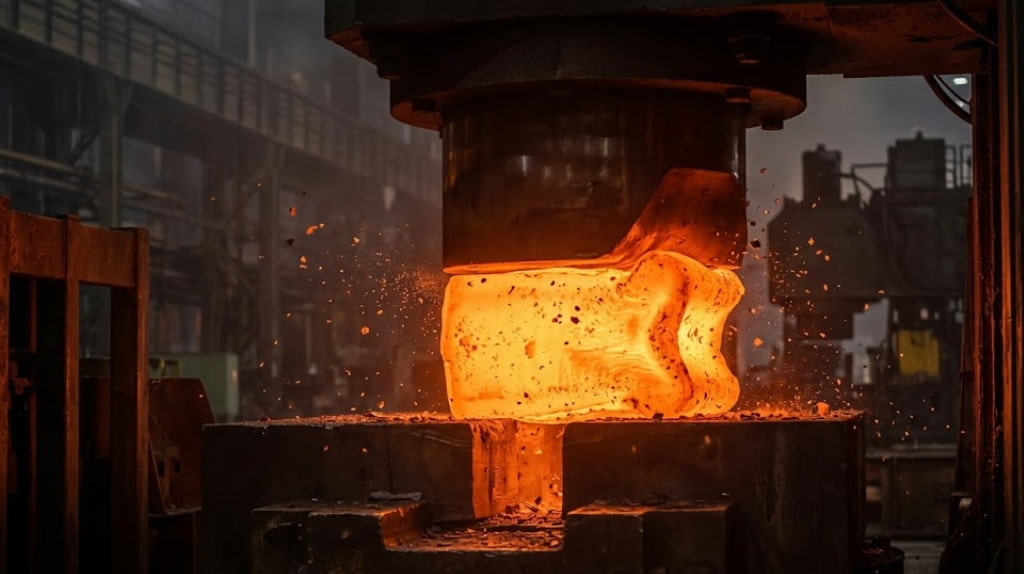
Metal forming is a group of industrial processes used to change the shape of a metallic material through plastic deformation, that is, a permanent transformation achieved by applying mechanical forces to the metal without removing material.
In practical terms, during the forming process the metal changes its geometry while maintaining almost the same original mass. This distinguishes metal forming from chip removal machining, where part of the material is removed using cutting tools to obtain the desired shape.
Forming operations include processes such as rolling, stamping, extrusion, drawing and forging, all of which are based on the ability of the metal to deform without breaking under controlled pressures or mechanical stresses. In contrast, operations such as turning, milling and drilling belong to material removal machining, as they modify the workpiece by progressively removing material in the form of chips.
Metal forming is one of the most important areas of modern metalworking, particularly in industrial sectors where high productivity, material optimization and the production of components with specific mechanical properties are required.
From an industrial perspective, forming makes it possible to manufacture complex metal components while reducing material waste, processing times and production costs, while maintaining good mechanical properties and the structural continuity of the material.
How Metal Forming Works
Metal forming is achieved by applying mechanical forces capable of permanently changing the shape of a material without removing any part of it. This process is based on the principle of plastic deformation, a characteristic of metals that allows them to deform permanently when the applied stresses exceed the so-called elastic limit.
As long as the material remains within the elastic range, it tends to return to its original shape once the applied force is removed. When the stress exceeds the elastic limit, however, the metal undergoes a permanent transformation and takes on a new geometry.
During the forming process, the material changes shape while maintaining essentially the same volume. This characteristic distinguishes forming operations from chip removal machining, where part of the metal is removed using cutting tools.
From an industrial perspective, forming can be carried out through compression, tension, bending or combinations of different mechanical stresses, depending on the process employed and the geometry required for the final component.
Metal forming technologies are mainly divided into hot forming and cold forming, two approaches with different operating characteristics.
In hot forming, the metal is processed at elevated temperatures, generally above its recrystallization temperature. Under these conditions, the material becomes more deformable and requires lower forces to be shaped. This makes it possible to achieve significant deformations and manufacture large components while reducing the risk of cracks or fractures during processing.
Hot forming is commonly used in processes such as heavy forging, rolling and the production of semi-finished metal products. However, high temperatures may affect the dimensional accuracy and surface quality of the component.
Cold forming, on the other hand, is performed at room temperature or without significant heating of the material. In this case, the metal offers greater resistance to deformation, but the process allows for tighter dimensional tolerances, improved surface finish and increased mechanical hardness due to work hardening.
This type of processing is widely used in the production of precision mechanical components, stamped sheet metal parts, profiles and components for highly specialized industrial sectors.
The choice between hot forming and cold forming depends on several factors, including the type of metal, component geometry, required mechanical properties, production volumes and the level of precision needed in the final product.
Main Metal Forming Processes
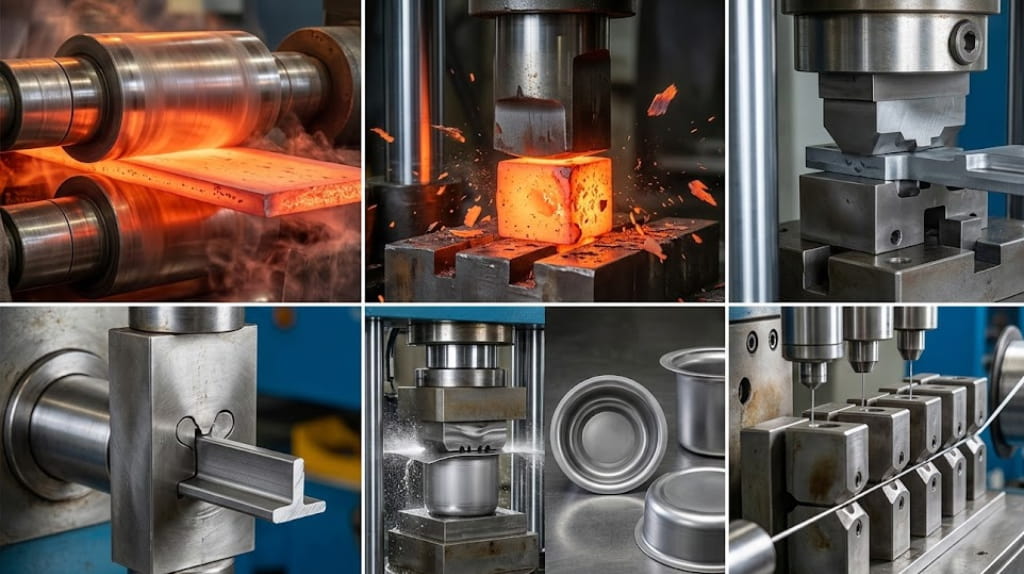
Metal forming includes a variety of industrial processes that use the plastic deformation of materials to produce components with specific shapes, dimensions and mechanical properties.
Each technology offers different advantages in terms of precision, productivity, achievable geometries and material behavior during processing.
One of the most widely used processes is rolling, which reduces the thickness of a metal by passing it between opposing rollers. This process is commonly employed in the production of sheets, strips, bars and metal profiles. Rolling can be performed either hot or cold, depending on the characteristics required for the final product.
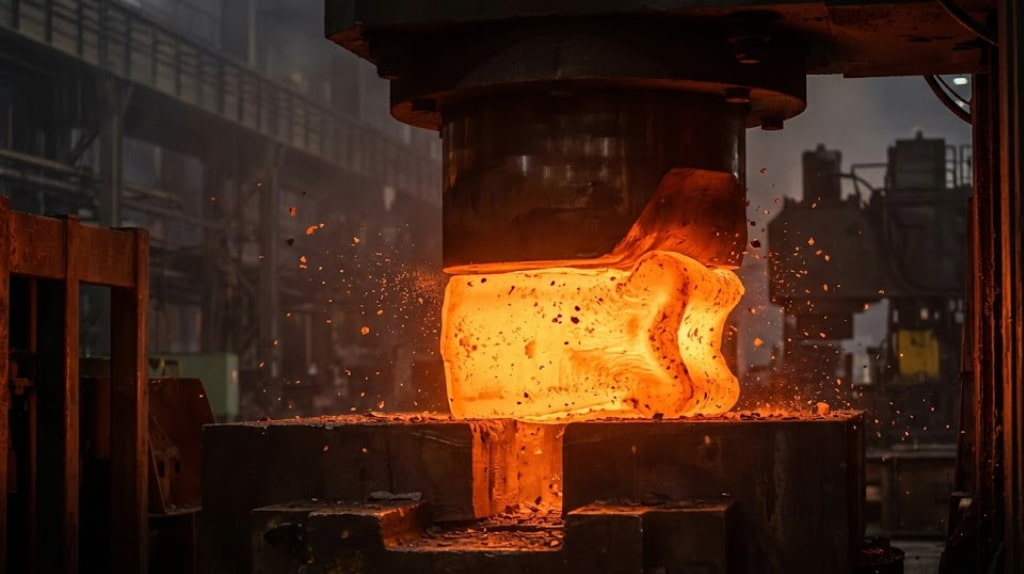
Hot forging involves deforming metal at elevated temperatures through compression applied by presses or hammers. Heating increases the material’s formability and makes it possible to produce highly resistant components, often used in the automotive, aerospace and energy sectors. This process also improves the continuity of the material’s internal structure, enhancing the mechanical strength of the finished part.
Cold forging uses the same compression-based deformation principle but is carried out at room temperature. This technology makes it possible to obtain components with high dimensional accuracy, excellent surface finish and increased hardness due to work hardening. It is particularly suitable for the high-volume production of mechanical elements such as bolts, screws and technical components.
Extrusion is a process in which metal is forced through a die to produce products with a constant cross-section. This technology is widely used to manufacture metal profiles, especially aluminum profiles, for applications in construction, transportation and mechanical engineering.
Stamping includes a range of operations performed mainly on sheet metal using presses and dedicated dies. Through controlled deformation, it is possible to manufacture components with complex geometries while maintaining high productivity and excellent process repeatability.
Among the most common stamping operations is deep drawing, a process used to transform a flat metal sheet into a hollow or three-dimensional component. This technology is widely applied in the production of automotive body parts, metal containers, industrial components and household appliance parts.
Drawing consists of reducing the cross-section of bars, wires or tubes by pulling the material through a die. This process makes it possible to obtain products with precise dimensions, improved surface finish and enhanced mechanical properties. Drawing is primarily used in the production of metal wires, tubing and components for mechanical and electrical applications.
Each forming process is selected according to the type of material, the characteristics required for the final component, production volumes and the level of precision needed for the intended industrial application.
Metals Commonly Used in Metal Forming
Metal forming is not applied in the same way to all metallic materials. The ability of a metal to undergo plastic deformation processes depends on its mechanical properties, microstructure and behavior under load.
One of the most important factors is ductility, which is the ability of a material to deform permanently without breaking. The greater the ductility of a metal, the more suitable it is for forming processes such as rolling, stamping, extrusion and forging.
Among the most commonly used materials are:
Carbon steels and alloy steels, which are widely employed in industrial manufacturing thanks to their good balance of mechanical strength, workability and cost. Steels can be formed both hot and cold, with different behaviors depending on their chemical composition and the heat treatments applied.
Aluminum is particularly well suited to forming processes due to its high deformability and low weight. Aluminum alloys are used in numerous industries, especially automotive, aerospace and construction, where reducing component weight while maintaining good mechanical properties is a key requirement.
Copper also offers high ductility and excellent workability. For this reason, it is commonly used in the production of pipes, electrical components, metal wires and parts manufactured through drawing or stamping processes.
Titanium can be formed as well, but it requires more controlled operating conditions than many other metals. Despite its high mechanical strength and excellent corrosion resistance, titanium is more challenging to process, particularly in cold forming applications, due to the high stresses involved during deformation.
Alongside traditional materials, special alloys are increasingly used for high-performance applications in the energy, aerospace and advanced manufacturing sectors. In these cases, the formability of the material depends heavily on its chemical composition, microstructure and the heat treatments performed before processing.
Not all metals, however, are suitable for severe plastic deformation. More brittle materials tend to crack or fracture during forming operations, especially when subjected to high mechanical stresses or rapid deformation rates.
Heat treatments also have a significant influence on material workability. Heating, annealing and other thermal processes can modify the hardness, strength and ductility of a metal, improving its ability to deform without compromising the structural integrity of the final component.
Chemical Composition Control in Metal Forming
In metal forming, controlling the chemical composition of the alloy is essential to ensure production stability, final component quality and proper material behavior during plastic deformation.
Even small variations in chemical composition can significantly affect how a metal responds during processes such as rolling, hot forging, cold forging, extrusion and stamping. For this reason, modern metallurgical production lines perform alloy verification both before and after material transformation.
Before processing begins, it is essential to verify that the material meets the required specifications. Elements such as carbon, manganese, chromium, nickel, molybdenum and aluminum directly influence the metal’s formability, mechanical strength and behavior during deformation. A material with an incorrect composition may require different forming forces, increase the risk of surface defects or promote crack formation during processing.
Chemical composition control is particularly important in rolling operations and in the production of plates and semi-finished products within large steelmaking facilities, where a high level of compositional consistency must be maintained throughout the production cycle. In advanced industrial environments, such as integrated steel and rolling mills, monitoring chemical composition helps ensure production continuity and stable material properties.
In hot forging, alloy composition directly affects material behavior at elevated temperatures. Certain alloying elements can influence the optimal processing temperature, formability and final metallurgical structure of the component.
In cold forging, chemical control becomes even more critical because the material is deformed at room temperature and must maintain the correct balance between strength and ductility. A non-compliant alloy can compromise precision, workability and the service life of the finished component.
Beyond formability, chemical composition also influences the material’s microstructure, namely the internal arrangement of metallurgical phases that determine the mechanical properties of the component. Variations in composition can affect hardness, toughness, wear resistance and performance under cyclic loading.
This aspect is particularly important for components subjected to severe mechanical stresses, where alloy quality has a direct impact on fatigue resistance and long-term operational reliability.
To ensure fast and accurate control throughout every stage of the forming process, the metallurgical industry relies on OES (Optical Emission Spectrometry) systems, which enable precise and repeatable verification of the chemical composition of metallic alloys both in the laboratory and directly on the production floor.
GNR Instruments for Quality Control in Metal Forming
In metal forming processes, fast and accurate control of the chemical composition of alloys is essential to ensure production stability, proper material formability and the quality of the final component. For this reason, metallurgical companies and metal processing industries rely on OES (Optical Emission Spectrometry) systems to monitor materials throughout every stage of production.
GNR OES spectrometers make it possible to verify the chemical composition of metallic alloys before forming, during production and in final quality control, helping to reduce errors, defects, rework and non-conformities.
In applications involving rolling, hot forging, cold forging, stamping and extrusion, chemical composition control is critical to maintaining consistent properties such as formability, hardness, mechanical strength and material behavior during plastic deformation.
For laboratory activities and quality control operations, GNR offers compact and versatile instruments such as the S1 MiniLab 150 and S3 MiniLab 300, designed for rapid analysis and routine metallurgical testing on both ferrous and non-ferrous materials.
For more advanced industrial applications, the S6 Sirius 500 features CMOS technology and broad elemental coverage, making it particularly suitable for production environments where high analytical speed, precision and the management of different alloy types are required.
The portable E3 Esaport and E4 Esaport Plus spectrometers enable on-site inspections directly on the production floor, on large components or on materials that are difficult to move, supporting rapid alloy verification and material sorting activities during manufacturing.
For highly specialized metallurgical laboratories and steelmaking facilities, GNR also offers advanced solutions such as the S5 Solaris Plus and S7 Metal Lab Plus, developed for applications requiring high analytical accuracy, long-term stability and comprehensive metallurgical quality control.
Thanks to OES spectrometry, GNR instruments support metal forming companies in monitoring the alloys used throughout production processes, helping to improve the reliability, repeatability and final quality of metal components.
Industrial Sectors That Use Metal Forming
Metal forming is used across numerous industrial sectors where it is necessary to manufacture metal components with high precision, production consistency and controlled mechanical properties. By allowing materials to be shaped without significant material removal, these processes make it possible to produce complex components efficiently and with a high degree of industrial repeatability.
In the automotive industry, metal forming is used to manufacture body panels, structural components, chassis parts, transmission systems and numerous mechanical components produced through stamping, deep drawing, rolling and forging. The ability to produce large volumes with controlled tolerances makes these processes essential to modern vehicle manufacturing.
The aerospace sector also relies heavily on metal forming for the production of aluminum, titanium and special alloy components used in aircraft structures, turbines, fasteners and high-performance mechanical parts. In this industry, manufacturing precision and control of metallurgical properties are critical to ensuring safety, lightweight design and operational reliability.
In the Oil & Gas industry, forming processes are used to manufacture pipes, flanges, pressure vessels, fittings and components designed to operate under severe conditions. Forging, rolling and drawing make it possible to obtain materials with high mechanical strength and excellent resistance to pressure, corrosion and fatigue.
Structural construction makes extensive use of formed metal components in the production of beams, profiles, sheets and steel structures used in buildings, infrastructure projects, bridges and industrial facilities. In this field, the ability to manufacture standardized components with consistent mechanical properties provides significant advantages from both production and engineering perspectives.
Metal forming is also central to the manufacture of industrial machinery, where it is used to produce frames, mechanical components, supporting structures and metal parts for production lines, automated systems and material handling equipment.
One of the main advantages of metal forming is its ability to support highly repeatable mass production, while maintaining dimensional consistency, uniform mechanical properties and optimized production times. For this reason, plastic deformation processes remain among the most important manufacturing technologies in modern industry.
Innovation in Metal Forming
Modern industrial technologies are making it possible to improve precision, production efficiency and metallurgical quality while simultaneously reducing scrap, energy consumption and downtime.
One of the most significant developments is the use of Finite Element Method (FEM) simulations in plastic deformation processes. A study published in the Journal of Materials Processing Technology highlights how advanced numerical modeling is now used to predict deformation, stress distribution, material flow and potential defects during forging, rolling, hot forming and cold forming operations.
Thanks to FEM simulations, manufacturers can optimize component geometries, process parameters and die designs before actual production begins, reducing errors, rework and industrial costs. This approach also improves final component quality and enhances the efficiency of the entire production cycle.
Technological innovation is also transforming production equipment. A study published in the journal Sensors (MDPI) examines the integration of smart sensors into industrial presses and forming systems. Modern “smart presses” are now capable of monitoring parameters such as applied force, vibration, temperature and material behavior in real time during processing.
These systems are among the key elements of Industry 4.0 applied to metallurgy, as they improve process control, traceability and production stability. However, mechanical monitoring alone is not sufficient: material behavior during deformation also depends on the chemical composition of the alloy and its metallurgical structure.
For this reason, forming process control is increasingly integrated with chemical analysis and metallurgical monitoring, which are essential for ensuring consistent material properties and production repeatability.
Another important area of innovation is real-time microstructural control during plastic deformation. A study published in Scientific Reports shows how advanced characterization techniques can monitor the evolution of metallurgical phases and microstructural behavior while the material is subjected to mechanical and thermal stresses.
The quality of a forming process depends not only on the final geometry of the component but also on the material’s internal structure. The chemical composition of the alloy directly influences how the metal responds to deformation, the formation of metallurgical phases and the final mechanical properties of the component.
Energy efficiency is also becoming an increasingly important factor in hot forming operations. The Iron and Steel Technology Roadmap published by the International Energy Agency (IEA) highlights how the steel industry is investing in technologies designed to reduce energy consumption and CO₂ emissions in rolling and forging processes.
In this context, precise control of thermal parameters plays a strategic role. Processing temperature, deformation rate and alloy behavior must be managed with great accuracy to avoid energy waste, metallurgical defects and production instability.
For this reason, chemical composition control through OES spectrometry has become a key support tool in modern advanced forming processes. Verifying alloy compliance before and after processing helps maintain process stability, metallurgical quality and the long-term reliability of the final component.
FAQ
Hot forming is performed at elevated temperatures, above the material’s recrystallization temperature. This makes the metal more deformable and allows large deformations to be achieved with lower forming forces. Cold forming, on the other hand, is carried out at room temperature and provides greater dimensional accuracy, improved surface finish and increased material hardness due to work hardening.
Yes. Plastic deformation processes directly affect the metal’s microstructure by changing grain arrangement, the distribution of metallurgical phases and internal stresses within the material. These changes influence the final mechanical properties of the component, including hardness, strength, ductility and fatigue performance.
The chemical composition of an alloy influences its formability, mechanical strength and behavior during processing. Elements such as carbon, chromium, nickel and molybdenum can modify hardness, ductility and the metal’s response to plastic deformation. Even small compositional variations can increase the risk of defects, cracking or process instability during operations such as rolling and forging.
Yes. After processes such as rolling, forging or stamping, dimensional, metallurgical and mechanical inspections are performed to verify that the component meets the required specifications. These checks may include non-destructive testing, mechanical testing, microstructural analysis and chemical composition verification of the alloy.
An OES spectrometer is used to verify the chemical composition of metallic alloys before processing, during production and during final quality control. Spectrometric analysis makes it possible to quickly identify compositional variations that could affect the material’s formability, microstructure and mechanical properties during forming operations.
The main quality control procedures in metal forming include dimensional inspections, surface checks, mechanical testing, microstructural analysis and chemical analysis of alloys. In many cases, non-destructive testing (NDT) techniques are also used to detect internal or surface defects without damaging the finished component.