
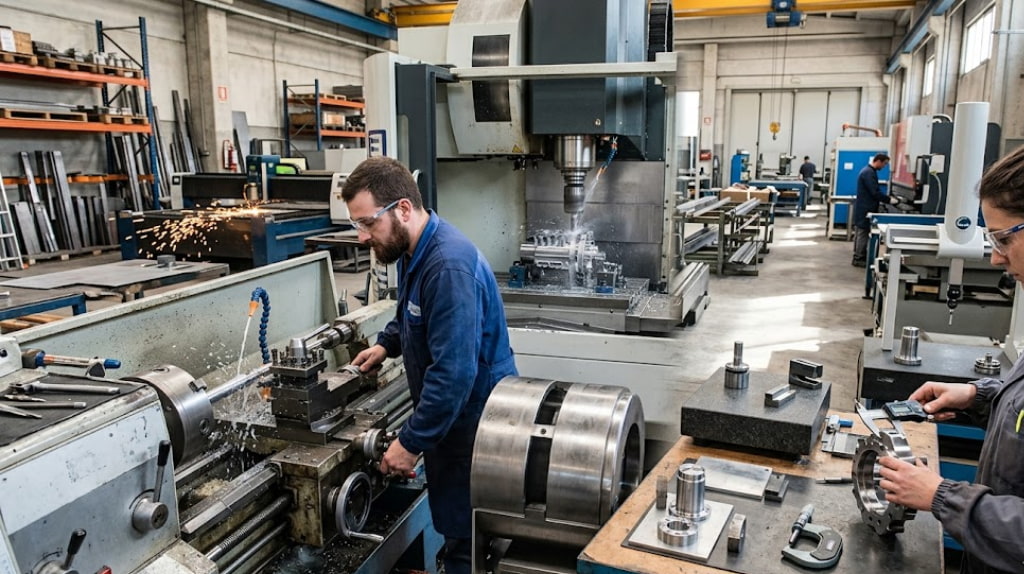
Metalworking machines are at the core of countless manufacturing processes. Every day, they transform raw metal materials into components used across industries such as automotive, aerospace, construction, energy, precision engineering and advanced manufacturing.
Today, however, machine performance depends on more than mechanical accuracy alone. The quality of the finished component is also closely linked to the properties of the material being processed. Alloy composition, metallurgical conformity and process control all have a direct impact on strength, machinability, durability and overall product reliability.
For this reason, modern workshops and manufacturing facilities complement machine tools with increasingly advanced quality control systems for alloy verification and process monitoring. Technologies such as Optical Emission Spectrometry (OES) enable fast and accurate analysis of the chemical composition of metals, reducing the risk of errors and ensuring compliance with the required specifications.
In this article, we explore the main metalworking machines, their role in industrial manufacturing processes, the technological innovations transforming the sector, and the growing importance of metallurgical quality control and analytical technologies in ensuring quality, safety and reliability throughout the production process, with a focus on the solutions developed by GNR Analytical Instruments Group.
What Are Metalworking Machines and What Are They Used For?
Metalworking machines are industrial systems and machine tools designed to transform raw metals and semi-finished materials into components with precise shapes, dimensions and mechanical properties. Through operations such as material removal, plastic deformation, cutting and finishing, they enable the production of parts for a wide range of industrial applications.
Machine tools represent one of the most important categories within this field. Lathes, milling machines, drilling machines, grinding machines and machining centers are used to perform high-precision machining operations, ensuring dimensional accuracy and compliance with engineering specifications.
Over the years, the industry has undergone a remarkable transformation. Traditional manually operated machines have progressively been replaced by Computer Numerical Control (CNC) systems and fully automated production equipment. These technologies make it possible to manufacture increasingly complex components while improving productivity, repeatability and process reliability.
However, machine accuracy is only one factor influencing the quality of the final product. To achieve consistent and reliable results, manufacturers must also ensure that the metal alloys used meet the required chemical specifications and that their properties remain under control throughout the production process.
For this reason, dimensional accuracy, surface quality and chemical composition control are now closely interconnected. Even the most advanced machine can only deliver its full potential when processing certified materials that have undergone rigorous metallurgical inspection at every stage of manufacturing.
The Main Machines Used in Metalworking
The manufacturing industry relies on a wide range of metalworking machines, each designed to perform specific operations with high levels of precision and productivity. The choice of machine depends on the type of process, the material being machined and the characteristics required for the finished component.
- Lathes – Used to machine cylindrical workpieces by rotating the component while cutting tools remove material. They are widely employed in the production of shafts, bushings, flanges and many other mechanical components for the automotive, energy and general engineering industries.
- Milling Machines – Designed to produce flat surfaces, slots, complex profiles and three-dimensional geometries. Thanks to the rotating cutting tool, milling machines are essential for manufacturing molds, tooling and precision-engineered parts.
- Industrial Drilling Machines – Used for drilling, boring, countersinking and tapping operations on metal components. Their versatility makes them indispensable in virtually every machine shop.
- Grinding Machines – Dedicated to high-precision finishing operations. Using abrasive wheels, they achieve extremely tight dimensional tolerances and superior surface finishes, making them essential for components requiring exceptional accuracy.
- CNC Machining Centers – Integrate multiple machining operations, including milling, drilling, tapping and, in some cases, turning, within a single system. Thanks to Computer Numerical Control (CNC) technology, they deliver high productivity, repeatability and process automation.
- Presses – Used to shape metals by applying high mechanical or hydraulic forces. They are employed in processes such as stamping, blanking, deep drawing and forging, serving a wide variety of industrial sectors.
- Press Brakes – Designed to bend metal sheets and profiles without removing material. Their precise control of the bending angle enables the production of structural components, metal enclosures and fabricated assemblies with high accuracy.
- Laser Cutting Machines – Use a high-energy laser beam to produce extremely precise and clean cuts on carbon steel, stainless steel, aluminum and many other metal alloys.
- Plasma Cutting Machines – Employ a high-temperature plasma jet to cut electrically conductive materials, including thick metal sections. They are widely used in heavy fabrication, steel construction and industrial manufacturing.
- Waterjet Cutting Machines – Use a high-pressure water jet, often combined with abrasive materials, to cut metals without introducing heat into the workpiece. This technology is particularly suitable for heat-sensitive materials and applications requiring maximum dimensional accuracy while preserving the metallurgical properties of the component.
Machines Used in the Main Metal Forming Processes
Machine tools represent only part of the metalworking industry. Many manufacturing processes rely on specialized equipment designed to shape metals through plastic deformation, casting or extrusion. In these applications, the quality of the finished product depends not only on machine performance but also on the careful control of the metal alloys being processed.
- Metal Extrusion – During the extrusion process, the material is forced through a die using powerful extrusion presses, producing profiles with constant cross-sections and complex geometries. This technology is widely used to manufacture aluminum, copper and other light-alloy components for the construction, automotive and industrial sectors. To ensure consistent mechanical properties and product quality, it is essential to verify the chemical composition of the alloy before processing.ì
- High-Pressure Die Casting – Die casting relies on dedicated die casting machines and advanced metal injection systems to force molten metal into permanent molds under high pressure. This process enables the production of components with excellent dimensional accuracy, high-quality surface finishes and short production cycles. As the use of secondary alloys continues to increase, chemical composition control becomes essential to ensure material conformity and consistent manufacturing performance.
- Metal Forming – Metal forming includes all manufacturing processes that change the geometry of a workpiece without removing material. The most common equipment includes mechanical presses, hydraulic presses and rolling mills, which are used to produce sheets, profiles and structural components for a wide range of industrial applications. Here too, the quality of the starting material has a direct impact on the final product. For this reason, metallurgical inspection plays a key role throughout the production process.
The Role of Optical Emission Spectrometry (OES) in Metal Alloy Quality Control
The precision of metalworking machines is essential, but it is not enough on its own to guarantee the quality of the finished component. Even the most advanced machine tool can produce non-compliant parts if the alloy being processed does not meet the required chemical specifications. For this reason, chemical composition control is a critical step throughout the entire manufacturing process.
Optical Emission Spectrometry provides fast and highly accurate determination of the chemical composition of metals and alloys. This technology is widely used to verify incoming materials, support production, quickly identify alloys and ensure that every component complies with the required specifications.
To meet the needs of different production environments, GNR Analytical Instruments Group develops a comprehensive range of OES spectrometers designed to support every stage of metallurgical quality control, from raw material verification to final product certification.
For production laboratories and routine inspections, S1 MiniLab 150 and S3 MiniLab 300 provide compact and reliable solutions for rapid alloy composition analysis, supporting day-to-day manufacturing activities.
For applications requiring greater flexibility, S5 Solaris Plus is designed to analyze a wide range of metallic matrices, making it an ideal choice for laboratories working with multiple alloy families.
When maximum analytical performance is required, S6 Sirius 500 delivers outstanding accuracy, stability and reliability, making it particularly suitable for central laboratories, advanced quality control and the analysis of complex alloys.
The product range also includes S7 Metal Lab Plus, a versatile spectrometer that combines analytical precision, operational speed and ease of use, providing an efficient solution for routine quality control in a broad range of industrial environments.
For inspections performed directly on the production floor or at customer facilities, GNR offers the portable E3 Esaport and E4 Esaport Plus spectrometers. These instruments enable rapid material identification and alloy verification without the need to transfer samples to a laboratory, reducing downtime and improving production efficiency.
Thanks to this complete product portfolio, OES accompanies the entire metalworking process—from raw material inspection and semi-finished product verification to final component certification. The result is a more reliable manufacturing process, enhanced material traceability and quality control that meets the highest industrial standards.
From Machining to Thermal Stress: Monitoring the Quality of the Finished Component
The quality of a metal component depends not only on machining operations or alloy composition. Throughout the manufacturing process, many parts undergo heat treatments such as quenching, tempering, annealing and stress relieving to achieve the required mechanical properties. However, these processes can also alter the material’s behavior and generate internal stresses.
Machining operations such as milling, turning, grinding, welding and cutting may likewise introduce residual stresses and distortions that can affect dimensional stability, fatigue resistance and the long-term performance of the component. For this reason, quality control does not end with chemical composition analysis but continues throughout the final stages of production.
Among the most advanced inspection techniques is the evaluation of thermal stress and residual stresses, which helps identify potential issues before components are put into service. These analyses are particularly important in the automotive, aerospace and energy industries, as well as in any application where reliability and safety are critical requirements.
To perform these inspections, manufacturers rely on X-ray Diffraction (XRD), a non-destructive technique capable of measuring residual stresses and evaluating the metallurgical condition of a material without altering its properties. The information obtained allows manufacturers to optimize production processes, verify the effectiveness of heat treatments and prevent distortions or premature failures during service.
Innovations Transforming Metalworking Machines
Metalworking machines are evolving rapidly through the integration of digital technologies, advanced automation and intelligent monitoring systems. Today, the goal is no longer simply to increase productivity, but also to make manufacturing processes more efficient, reliable and sustainable throughout the entire production cycle.
Among the most significant innovations are Digital Twins—virtual models that replicate the behavior of machine tools in real time. By continuously synchronizing operational data with a digital model, manufacturers can simulate production scenarios, optimize machine performance and detect potential issues before they become real problems. The scientific review Digital Twins for Machine Tools: A Systematic Mapping Study (2025) highlights how digital twins can improve the reliability, productivity and performance monitoring of CNC machine tools. Readers interested in this topic can explore the full study published by Taylor & Francis.
Digital Twins are also one of the key technologies driving intelligent manufacturing. The study Digital Twins Enabling Intelligent Manufacturing (2024) explains how integrating virtual models, real-time production data and advanced decision-making systems can reduce production times, optimize costs and improve overall manufacturing efficiency. This publication offers valuable insights into the evolution of today’s smart factories.
Alongside Digital Twins, artificial intelligence (AI) is playing an increasingly important role in predictive maintenance. By analyzing data collected from IoT sensors and monitoring systems, AI algorithms can detect early signs of wear or malfunction, allowing maintenance activities to be scheduled before failures occur. The systematic review AI-Driven Predictive Maintenance for Industry 4.0 examines how artificial intelligence, the Internet of Things (IoT) and Big Data are transforming industrial maintenance, enabling the transition from preventive maintenance to predictive and even prescriptive maintenance strategies. This study provides an excellent overview of how maintenance is evolving in modern manufacturing.
These innovations are made possible by IoT sensors, which continuously collect data on vibration, temperature, energy consumption, machining speed and many other operating parameters. Integrating this information with production equipment, software platforms and measurement systems enables real-time production monitoring, supporting faster decision-making, greater operational efficiency and improved process traceability.
Together, these technologies form the foundation of the Smart Factory and Industry 4.0, where machine tools, software platforms and quality control systems operate as a fully connected ecosystem. In this environment, the evolution of manufacturing equipment requires increasingly accurate control of materials, metal alloys and production processes.
FAQ
The main types of metalworking machines include lathes, milling machines, industrial drilling machines, grinding machines, CNC machining centers, presses, press brakes, and laser, plasma and waterjet cutting machines. Each is designed to perform specific manufacturing operations, from material removal and plastic deformation to cutting and finishing metal components.
A lathe machines primarily cylindrical workpieces by rotating the component while the cutting tool removes material. A milling machine, on the other hand, uses a rotating cutting tool to machine a generally stationary workpiece, making it possible to produce flat surfaces, slots, complex profiles and three-dimensional geometries.
High-pressure die casting mainly relies on die casting machines and metal injection systems that force molten metal into permanent molds under high pressure. To ensure consistent product quality, manufacturers must also carefully control the chemical composition of the alloys, particularly when using recycled or secondary materials.
Metal extrusion uses extrusion presses, dies and material handling systems. During the process, the metal is forced through a die to produce profiles with a constant cross-section. Verifying the chemical composition of the alloy is essential to ensure the required mechanical properties of the extruded product.
Modern metalworking machines increasingly integrate Digital Twins, IoT sensors, artificial intelligence, predictive maintenance systems and real-time production monitoring. The integration of machines, software platforms and measurement systems improves productivity, quality, traceability and operational efficiency, making materials and process control more important than ever.