Iron processing encompasses a series of manufacturing operations that transform iron ore extracted from the earth into finished or semi-finished products for a broad range of applications. From the production of cast iron and steel to machining, heat treatments and final inspections, every stage contributes to the performance, quality and reliability of the final material.
Iron is one of the most widely used materials in modern industry. Thanks to its mechanical properties, the availability of raw materials and its ability to be transformed into a wide range of alloys, it forms the foundation of countless industrial applications, from large-scale infrastructure projects to precision-engineered mechanical components.
Today, iron processing is increasingly supported by digital technologies, automated production systems and advanced analytical instruments. Verifying alloy composition, monitoring manufacturing processes and controlling metallurgical properties make it possible to produce components that comply with stringent quality standards while reducing the risk of defects throughout the production chain.
In this article, we examine the main iron processing stages, the most widely used industrial techniques, the key application sectors and the increasingly strategic role of quality control and analytical technologies in ensuring performance, safety and reliability throughout the entire metallurgical production process.
What Is Iron Processing and Why Is It Essential to Modern Industry?
Iron processing encompasses all the industrial operations that transform iron ore or semi-finished materials into components for a wide variety of applications. Through machining, plastic deformation, heat treatments and metallurgical inspections, iron is adapted to meet the specific performance requirements of different industries.
It is important to distinguish iron from materials such as steel and cast iron, which are often used interchangeably in everyday language. Iron is the basic chemical element, while steel is an alloy composed primarily of iron and carbon, often combined with additional alloying elements to achieve specific mechanical and chemical properties. Cast iron, on the other hand, contains a higher carbon content than steel and is particularly well suited to casting processes because of its excellent fluidity. For this reason, industrial manufacturing relies far more extensively on steel and cast iron than on nearly pure iron.
The ability to produce materials with very different mechanical characteristics makes iron and its alloys indispensable to modern industry. Properties such as strength, ductility, machinability and durability can all be tailored through the selection of the appropriate alloy and manufacturing process.
As a result, iron forms the backbone of numerous industrial supply chains. It is widely used in construction for structural frameworks and infrastructure projects, in the automotive industry for mechanical and structural components, in mechanical engineering for machinery, tools and production equipment, in the energy sector for power plants, turbines and transmission systems, and in the construction of bridges, railways, industrial facilities and critical infrastructure, where reliability and mechanical performance are essential.
Thanks to the continuous evolution of manufacturing technologies and quality control systems, iron processing remains one of the cornerstones of modern metallurgy and advanced manufacturing.
From Raw Material to Finished Product: The Main Stages of Iron Processing
Iron processing is the result of a complex production chain in which every stage contributes to defining the mechanical properties, quality and performance of the final material. From iron ore extraction to final inspection, each step requires dedicated technologies and rigorous process control.
- Iron Ore Extraction – The production cycle begins with the extraction of iron ore from mines. After crushing and beneficiation, the ore is prepared for the subsequent processing stages. To learn more about this topic, read our article on mining and mineral extraction.
- Cast Iron Production – The ore is converted into cast iron inside a blast furnace through a reduction process that removes oxygen from iron oxides. Cast iron serves as the starting material for the production of most steel grades.
- Steel Production – Cast iron is subsequently refined in steelmaking plants to reduce its carbon content and produce steels with specific chemical compositions and mechanical properties. At this stage, alloying elements such as chromium, nickel and molybdenum are often added to enhance the material’s performance.
- Melting and Casting – Molten steel is cast into ingots, blooms, billets or slabs, which become the semi-finished products for subsequent manufacturing operations. The quality of the casting process has a direct impact on the material’s homogeneity and structural integrity.
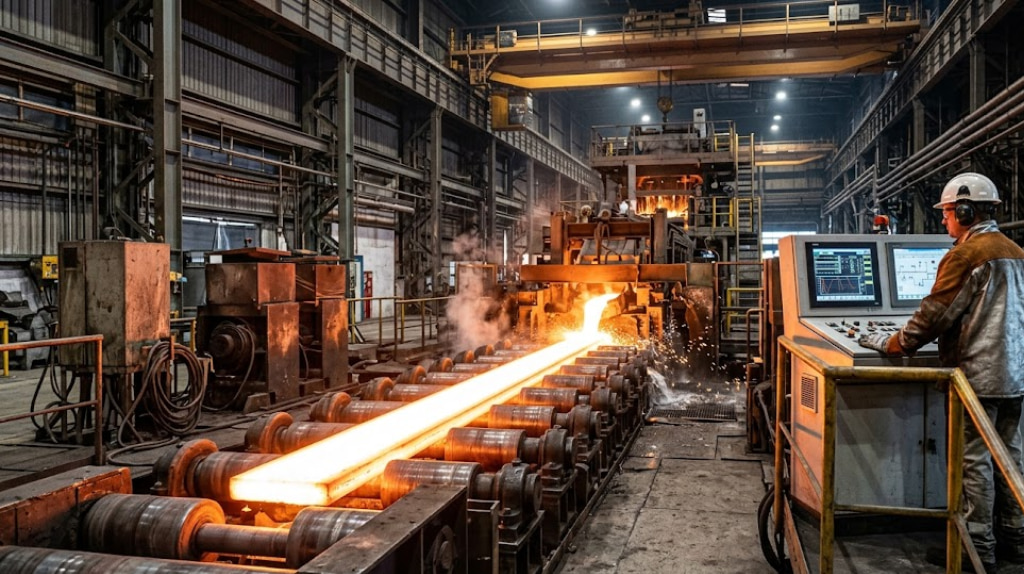
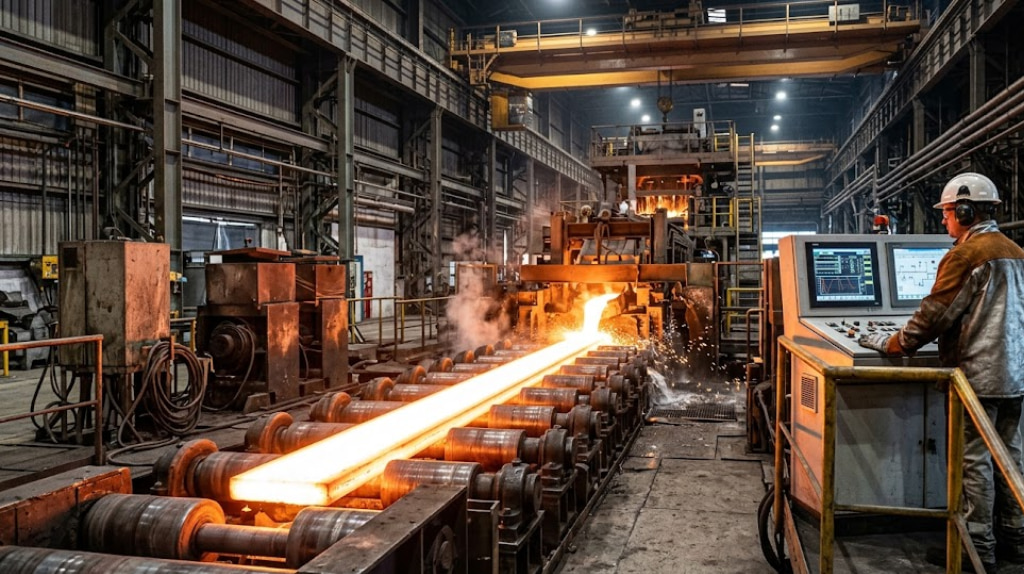
- Rolling – Using rolling mills, the material is plastically deformed to produce sheets, bars, sections and other semi-finished products with controlled dimensions. Rolling is one of the most widely used processes in modern steel production.
- Forging – Through the use of presses or power hammers, the material is plastically deformed to improve its internal structure and enhance its mechanical properties. This technique is particularly suitable for manufacturing high-strength components intended for demanding applications.
- Machining – Turning, milling, drilling, grinding and other precision machining operations give the component its final geometry while ensuring compliance with strict dimensional tolerances. To learn more about these processes, read our article on metalworking processes.
- Heat Treatment – Processes such as quenching, tempering, annealing and stress relieving modify the material’s microstructure, improving hardness, strength, toughness or machinability depending on the intended application.
- Final Inspection – Before components are delivered or put into service, they undergo dimensional, mechanical and metallurgical inspections. Verifying chemical composition, material properties and the absence of defects is essential to ensure quality, compliance and long-term reliability.
Every stage of the manufacturing process directly influences the final characteristics of iron and its alloys. For this reason, modern metallurgy integrates production technologies, quality control and advanced analytical techniques throughout the entire manufacturing chain, ensuring materials that consistently meet specifications and deliver reliable performance over time.
The Main Iron Processing Techniques
After steel has been produced, iron and its alloys can be transformed through a variety of manufacturing techniques, each designed to achieve specific geometrical, mechanical and functional properties. The choice of process depends on the type of component being manufactured, production volumes and the required performance characteristics.
- Rolling – Rolling consists of passing the material through a series of rollers that progressively reduce its thickness or modify its cross-section. The process can be performed either hot or cold and is used to produce steel sheets, bars, structural sections and beams for the construction, mechanical engineering and manufacturing industries. Its main advantages include high productivity, excellent material uniformity and the ability to manufacture large semi-finished products.
- Forging – Forging plastically deforms the metal using presses or power hammers, either at high or room temperature. This process improves the internal structure of the material, increasing its mechanical strength, toughness and reliability. It is widely used to manufacture shafts, gears, flanges and critical components for the automotive, energy and aerospace industries.
- Stamping – Stamping enables the high-volume production of components with repeatable geometries through the use of dedicated dies. The process ensures excellent dimensional accuracy, short production cycles and cost-effective mass manufacturing. Typical applications include automotive body parts, structural components, household appliances and a wide variety of industrial products.
- Turning and Milling – These precision machining processes produce the final geometry of a component by removing material. Turning is primarily used for cylindrical parts, while milling allows the production of flat surfaces, complex profiles and three-dimensional geometries. Both techniques are essential for manufacturing high-precision mechanical components.
- Welding – Welding permanently joins two or more metal components through the application of heat, pressure or a combination of both. Several welding methods are available, including MIG, TIG, arc welding and laser welding, each suited to specific applications. Welding plays a fundamental role in the fabrication of steel structures, industrial plants, infrastructure, transportation systems and heavy machinery.
The combination of these manufacturing techniques makes it possible to produce components with a wide variety of mechanical and dimensional characteristics. For this reason, every stage of production must be supported by rigorous material and process control to ensure consistent quality, compliance and performance throughout the entire manufacturing chain.
The Role of Optical Emission Spectrometry (OES) in Iron Processing
The quality of iron processing depends not only on the efficiency of manufacturing equipment but also on the chemical composition of the material being processed. Even slight variations in the content of carbon or alloying elements can significantly affect properties such as mechanical strength, hardness, weldability, machinability and the material’s response to heat treatment. For this reason, chemical composition control is a fundamental step throughout the entire production chain.
Optical Emission Spectrometry (OES) is one of the most widely used analytical techniques in the steel industry for rapid alloy identification, material verification, process monitoring and product certification. Thanks to its speed and analytical accuracy, OES enables manufacturers to detect deviations from specifications at an early stage, reducing scrap, rework and production costs.
To meet the needs of different manufacturing environments, GNR Analytical Instruments Group develops a comprehensive range of OES spectrometers designed to support every stage of metallurgical quality control, from raw material identification to final product certification.
For production laboratories and routine quality inspections, S1 MiniLab 150 and S3 MiniLab 300 provide compact and reliable solutions for rapid chemical analysis of iron, steel and other metal alloys.
For applications requiring greater flexibility, S5 Solaris Plus is designed to analyze a wide range of metallic matrices, making it suitable for laboratories working with multiple alloy families.
When the highest level of analytical performance is required, S6 Sirius 500 delivers outstanding accuracy, stability and reliability, making it particularly well suited for central laboratories, advanced quality control and material certification.
The product range also includes S7 Metal Lab Plus, a versatile spectrometer that combines analytical precision, operational speed and ease of use, providing an efficient solution for routine quality control in steel plants and metallurgical facilities.
For inspections performed directly on the production floor or at customer sites, GNR offers the portable E3 Esaport and E4 Esaport Plus spectrometers. These instruments enable rapid material identification and alloy verification without the need to transfer samples to a laboratory, improving inspection efficiency and reducing production downtime.
In addition to chemical composition analysis, many applications also require the evaluation of the effects of machining operations and heat treatments on the material. To learn more about this topic, read our article on thermal stress in metals and advanced analytical techniques.
Thanks to this comprehensive product portfolio, OES supports every stage of iron processing—from raw material inspection to final product certification—helping manufacturers ensure quality, compliance, traceability and reliability throughout the entire production process.
Innovations Transforming Iron Processing
Iron processing is undergoing a profound transformation driven by digital technologies, advanced automation and new production models focused on sustainability. Today, the objective is not only to increase productivity but also to improve plant efficiency, reduce energy consumption and achieve more accurate control over materials and manufacturing processes.
One of the main drivers of this evolution is Industry 4.0, which enables steel plants, manufacturing equipment, management software and measurement systems to operate within a fully connected digital ecosystem. By integrating data from every stage of production, manufacturers can monitor operations in real time, optimize process parameters and respond quickly to potential issues.
Artificial intelligence (AI) is also playing an increasingly important role in metallurgical production. By analyzing data collected throughout the manufacturing process, AI algorithms support quality control, predictive maintenance and process optimization, improving both efficiency and operational reliability. The report Digitalization in the Steel Industry, published by McKinsey, examines how digitalization, automation and artificial intelligence are reshaping steel production, highlighting their impact on productivity, plant performance and operational decision-making. Readers interested in this topic can explore the full McKinsey publication for further insights.
At the same time, Digital Twins are becoming increasingly common in steelmaking plants. These virtual models replicate the behavior of blast furnaces, rolling mills and other production equipment in real time, making it possible to simulate operating scenarios, predict critical issues and optimize plant performance before implementing changes in the physical production environment.
Continuous production monitoring is further enhanced through the use of Internet of Things (IoT) sensors, which collect real-time data on temperature, energy consumption, processing speed and material quality. Integrating this information improves process traceability and enables faster, data-driven decision-making across the production chain.
Innovation is also accelerating the decarbonization of the steel industry. The growing adoption of green steel and the development of low-carbon steelmaking technologies represent some of the sector’s most significant challenges. The Green Steel Tracker, developed by the Leadership Group for Industry Transition (LeadIT), monitors major international investments and projects focused on low-carbon steel production, providing an up-to-date overview of the global transition toward more sustainable steelmaking. The platform is an excellent resource for readers interested in following the evolution of green steel initiatives worldwide.
This trend is further confirmed by the Sustainability Indicators published by the World Steel Association, which document the progress of the global steel industry in terms of energy efficiency, CO₂ emissions reduction and technological innovation. These reports clearly demonstrate that sustainability and industrial competitiveness are becoming increasingly interconnected.
In this evolving landscape, advances in iron processing require ever more accurate control of materials, metal alloys and manufacturing processes. Analytical technologies such as Optical Emission Spectrometry (OES) and X-ray Diffraction (XRD) have therefore become essential tools for ensuring quality, compliance, traceability and reliability throughout the entire metallurgical production chain.
FAQ
Iron processing includes all the industrial operations that transform iron ore or semi-finished materials into finished products for a wide range of applications. The production cycle includes stages such as cast iron and steel production, melting, casting, rolling, forging, machining, heat treatment and quality control, each of which plays a fundamental role in determining the final properties of the material.
The main iron processing techniques include rolling, forging, stamping, turning, milling and welding. Each process serves a specific manufacturing purpose: rolling is used to produce sheets and structural sections, forging enhances the mechanical properties of the material, stamping is ideal for high-volume production, while turning and milling provide the precision required for complex mechanical components.
In the metallurgical industry, iron and its alloys are primarily analyzed using Optical Emission Spectrometry (OES), which enables rapid determination of chemical composition, alloy verification and process control. For more advanced metallurgical investigations, techniques such as X-ray Diffraction (XRD) are also employed to evaluate residual stresses, microstructure and other material characteristics.
Processed iron is widely used across numerous industrial sectors. The main applications include construction, automotive, mechanical engineering, energy and infrastructure, where it is employed to manufacture structural frameworks, mechanical components, industrial machinery, production plants, bridges, railway systems and civil engineering structures. Thanks to its strength, versatility and durability, iron remains one of the most important materials in modern industry.