
Aluminum die casting is one of the most widely used manufacturing processes for producing lightweight, durable metal components with complex geometries. Thanks to its ability to manufacture large volumes of parts with high dimensional accuracy and excellent repeatability, this technology is widely adopted across industries ranging from automotive and electric mobility to mechanical engineering and electronics.
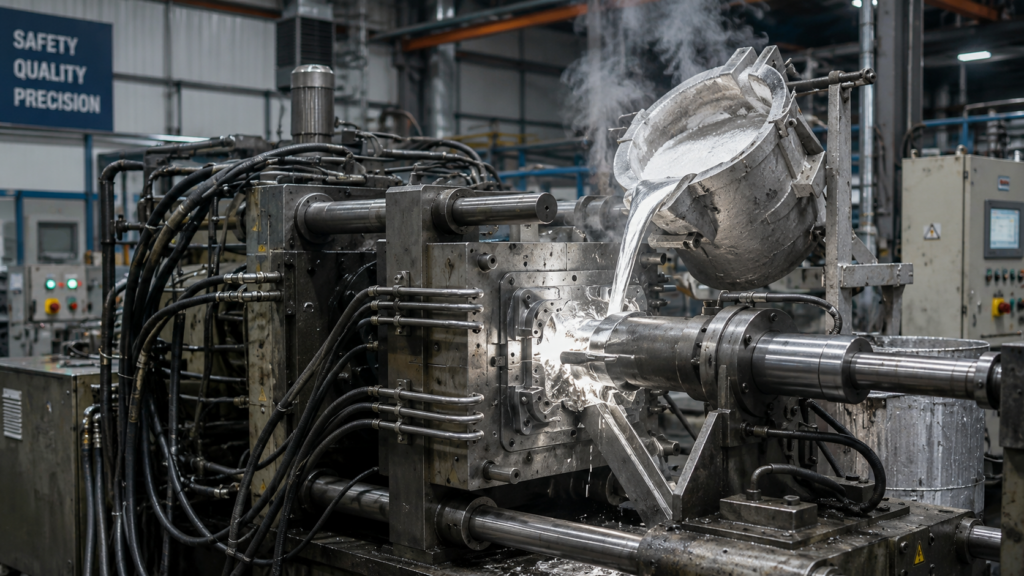
The aluminum die casting process consists of injecting molten aluminum alloy into a permanent metal mold under high pressure. This technique makes it possible to produce components with tight dimensional tolerances, high-quality surface finishes and very short production cycles, making it ideal for high-volume manufacturing.
As with any metallurgical process, however, the quality of the finished component depends on several factors. Alloy selection, temperature control, injection pressure and proper management of the entire production cycle all have a direct impact on the mechanical, dimensional and aesthetic properties of the die-cast part.
In this article, we examine the aluminum die casting process in detail, including its main production stages, the most commonly used alloys, the advantages of the technology, potential manufacturing defects, the importance of quality control and the contribution of the analytical technologies developed by GNR Analytical Instruments Group for monitoring the chemical composition of aluminum alloys.
What Is Aluminum Die Casting?
Aluminum die casting is a manufacturing process in which molten aluminum alloy is injected under high pressure into a permanent metal mold. Once the mold cavity has been completely filled, the metal rapidly solidifies, after which the component is ejected, finished and subjected to the required quality control procedures.
Unlike traditional casting, where molten metal is generally poured into the mold by gravity, die casting uses high injection pressures that allow the mold cavity to be filled in a very short time, even when producing highly complex geometries. As a result, manufacturers can produce components with excellent dimensional accuracy, outstanding repeatability and high-quality surface finishes while minimizing the need for subsequent machining operations.
These characteristics have made aluminum die casting one of the preferred manufacturing technologies for the mass production of components used in the automotive, electronics, electromechanical, lighting, electric mobility and industrial machinery sectors.
The process is also highly valued because it fully exploits the properties of aluminum—a lightweight, corrosion-resistant and fully recyclable material. Moreover, the possibility of using both primary aluminum and secondary aluminum alloys makes die casting an increasingly important technology in the context of the circular economy and sustainable manufacturing.
This is one of the reasons why aluminum die casting has become one of the most widely adopted processes for manufacturing components in high-volume industrial production.
For a broader overview of die casting technologies and their applications in metal manufacturing, read our article on Metal Die Casting: Process, Materials and Quality Control.
How Does the Aluminum Die Casting Process Work?
The aluminum die casting process consists of a sequence of carefully controlled stages, each of which has a direct impact on the quality of the finished component. Alloy temperature, injection pressure, filling speed and cooling time must all be precisely managed to produce parts that meet the required specifications.
- Alloy Preparation – The process begins with the selection of the aluminum alloy best suited to the intended application. At this stage, it is essential to verify the chemical composition of the material, particularly when secondary alloys or recycled aluminum are used.
- Aluminum Melting – The alloy is melted in dedicated furnaces under carefully controlled conditions to preserve its metallurgical properties and prevent contamination.
- Temperature Control – Before injection, the temperature of the molten metal is continuously monitored. Incorrect temperatures can compromise alloy fluidity, mold filling and the overall quality of the casting.
- Injection into the Mold – The molten aluminum is injected into the permanent metal mold under high pressure using a die casting machine. Injection speed and pressure are critical parameters for ensuring complete and uniform filling of the mold cavity.
- Cavity Filling – The molten metal rapidly fills every section of the mold, accurately reproducing complex geometries, thin walls and fine details.
- Cooling and Solidification – Once the mold cavity has been filled, the alloy solidifies quickly through contact with the metal mold, taking on the final shape of the component.
- Part Ejection – After solidification, the mold is opened and the die-cast component is automatically ejected, ready for subsequent finishing operations.
- Finishing and Quality Control – The component then undergoes trimming, finishing and dimensional and metallurgical inspections. At this stage, manufacturers verify alloy conformity, check for the presence of defects and ensure that the component meets all required technical specifications.
The entire process is influenced by several key parameters. Temperature, injection pressure, filling speed and alloy composition all directly affect mechanical strength, dimensional accuracy, surface quality and the occurrence of defects such as porosity or shrinkage. To learn more about metal melting and transformation processes, read our article on Metal Casting: How the Process Works.
Advantages of Aluminum Die Casting
Aluminum die casting is one of the most widely adopted manufacturing technologies for producing metal components because it combines high productivity, precision and cost efficiency. For this reason, it is extensively used in industries such as automotive, electric mobility, electronics, mechanical engineering and advanced manufacturing.
Its main advantages include:
- High Productivity – Aluminum die casting enables the large-scale production of components with very short cycle times. Since permanent molds can be used for thousands of production cycles, the process is particularly cost-effective for high-volume manufacturing.
- Excellent Dimensional Accuracy – High-pressure injection makes it possible to produce components with tight tolerances and outstanding repeatability, minimizing variations between individual parts.
- Complex Geometries – The process allows manufacturers to produce components with intricate shapes, thin walls, ribs and fine details that would be difficult or uneconomical to achieve using other manufacturing technologies.
- Lightweight Components – Aluminum alloys significantly reduce component weight compared to many other metallic materials, contributing to improved energy efficiency and overall product performance.
- High-Quality Surface Finish – Die-cast components generally feature smooth, uniform surfaces that are often suitable for subsequent treatments such as painting, anodizing or decorative finishing with minimal additional preparation.
- Reduced Secondary Machining – Thanks to the precision of the process, many components require only limited finishing operations, resulting in lower manufacturing costs and shorter production times.
- Excellent Strength-to-Weight Ratio – Aluminum alloys used in die casting provide an outstanding balance between low weight and mechanical strength, making them particularly suitable for structural and high-performance applications.
These advantages explain why demand for die-cast aluminum components continues to grow across multiple industries. In the automotive and electric mobility sectors, for example, reducing vehicle weight contributes directly to improved energy efficiency and extended driving range. Likewise, manufacturers in the mechanical engineering and electromechanical industries benefit from the ability to produce complex, reliable and highly repeatable components while maintaining high quality standards and competitive production costs, even in large manufacturing volumes.
To learn more about the technologies used to transform metallic materials, read our article on Metalworking: Processes, Stages and Machinery.
The Role of GNR Spectrometers in Aluminum Die Casting
In aluminum die casting, the quality of the finished component largely depends on the chemical composition of the alloy. Even slight variations in the content of silicon, copper, magnesium, iron or other alloying elements can significantly affect key properties such as fluidity, mechanical strength, ductility, corrosion resistance and solidification behavior. For this reason, chemical composition control is a critical step throughout the entire manufacturing process.
Optical Emission Spectrometry (OES) is one of the analytical techniques most widely used in foundries for rapid alloy identification, material verification, process monitoring and final product certification. Thanks to its speed and high analytical accuracy, OES enables manufacturers to detect deviations from specifications at an early stage, reducing scrap, rework and production costs.
To meet the requirements of different production environments, GNR Analytical Instruments Group develops a comprehensive range of OES spectrometers designed to support every stage of metallurgical quality control, from raw material identification to final product certification.
For production laboratories and routine quality inspections, S1 MiniLab 150 and S3 MiniLab 300 provide compact and reliable solutions for rapid analysis of the aluminum alloys used in die casting.
For applications requiring greater versatility, S5 Solaris Plus is designed to analyze a wide range of metallic matrices, making it an excellent choice for foundries and laboratories working with multiple alloy families.
When maximum analytical performance is required, S6 Sirius 500 delivers outstanding accuracy, stability and reliability, making it particularly suitable for central laboratories, advanced quality control and alloy certification.
The product range also includes S7 Metal Lab Plus, a versatile spectrometer that combines analytical precision, operational speed and ease of use, providing an efficient solution for routine quality control in foundries and companies manufacturing die-cast components.
During the aluminum die casting process, these instruments support several critical stages of production:
- Inspection of scrap and secondary aluminum, verifying the chemical composition of material intended for remelting.
- Alloy verification before casting, ensuring that the chemical composition complies with production specifications.
- Process monitoring, maintaining consistent alloy quality throughout the manufacturing cycle.
- Final quality control, certifying the conformity of die-cast components before they are released for use.
Thanks to this comprehensive portfolio of solutions, OES supports the entire aluminum die casting process, helping manufacturers ensure quality, compliance, traceability and reliability throughout the production chain.
Aluminum Die Casting and Other Metalworking Processes
Aluminum die casting is one of the main technologies used to manufacture metal components, but it is only one of several production processes employed throughout the manufacturing industry. The most suitable process depends on factors such as component geometry, required mechanical properties, production volume and the type of material being processed.
When the objective is to produce profiles with a constant cross-section, manufacturers often choose metal extrusion, a process widely used for aluminum and other lightweight alloys.
When a component must be shaped without removing material, manufacturers rely on metal forming processes such as rolling, forging and stamping.
Die casting is a specialized high-pressure casting technology, but it is only one of several methods used to transform metals into finished components. In our article Metal Die Casting: Process, Materials and Quality Control, you can compare the different die casting technologies, the alloys commonly used and the quality control procedures applied throughout production.
After casting, many components undergo additional machining operations, heat treatments and surface finishing. These processes can generate residual stresses that influence component performance and long-term reliability. Our article on Thermal Stress in Metals explains how these stresses develop and which analytical techniques are used to evaluate them.
When the starting material is iron or steel, the manufacturing route follows a different production chain that includes cast iron production, steelmaking, rolling, forging, machining and metallurgical inspections. All these stages are described in our article Iron Processing: Processes, Techniques and Quality Control.
Although each manufacturing process has its own characteristics and applications, they all share the same objective: producing components that meet strict dimensional, mechanical and metallurgical requirements. Regardless of the technology employed, verifying alloy composition, metallurgical properties and final component quality is essential to ensure quality, compliance, traceability and reliability throughout the entire manufacturing process.
FAQ
Aluminum die casting is a manufacturing process in which molten aluminum alloy is injected under high pressure into a permanent metal mold. This technology makes it possible to produce components with high dimensional accuracy, excellent surface finish and very short production cycles, making it particularly suitable for high-volume manufacturing.
The process consists of several stages: alloy preparation, aluminum melting, temperature control, injection into the mold, cavity filling, cooling and solidification, part ejection, finishing and quality control. Parameters such as temperature, injection pressure, filling speed and alloy composition have a direct influence on the characteristics and quality of the finished component.
The most commonly used alloys are aluminum-silicon (Al-Si) and aluminum-silicon-copper (Al-Si-Cu) alloys, valued for their excellent castability, mechanical strength and dimensional stability. Depending on the application, alloys containing magnesium or other alloying elements may also be selected to improve specific properties such as strength, hardness or corrosion resistance.
Die-cast aluminum offers numerous advantages, including high productivity, excellent dimensional accuracy, the ability to produce complex geometries, lightweight components, high-quality surface finishes, reduced secondary machining and an outstanding strength-to-weight ratio. These characteristics make it widely used in the automotive, electric mobility, mechanical engineering and electronics industries.
The most common defects include porosity, solidification shrinkage, gas blowholes, inclusions, cracks and incomplete mold filling. Proper control of process parameters and careful verification of alloy composition are essential to minimize these defects and ensure consistent component quality.
The chemical composition of an aluminum alloy directly influences properties such as fluidity, mechanical strength, hardness, ductility, corrosion resistance and solidification behavior. For this reason, Optical Emission Spectrometry (OES) is widely used to verify alloy conformity before casting, monitor production and certify the quality of finished die-cast components.